-
 May 7, 2026
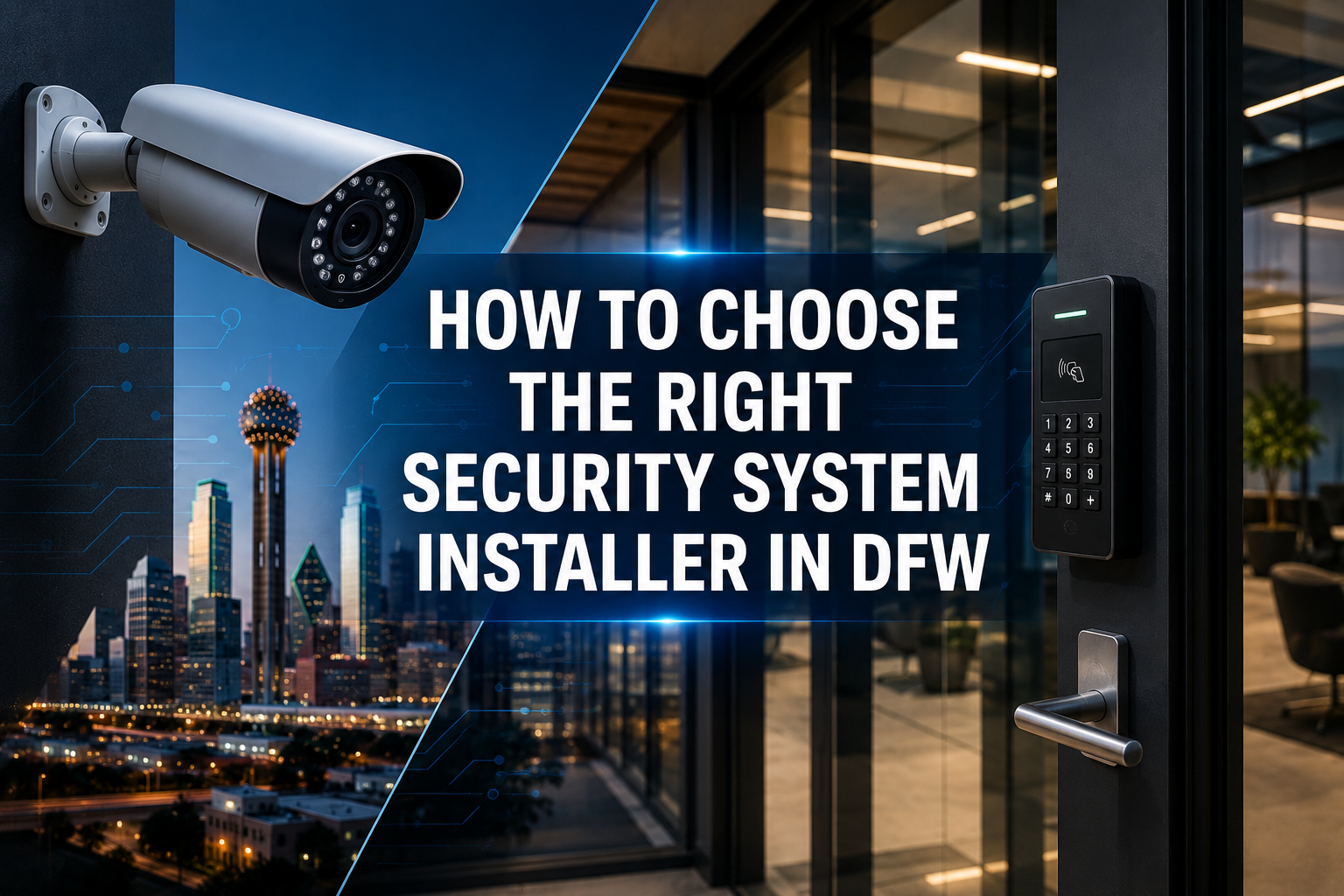
How to Choose the Right Security System Installer in DFW?
Most business owners don’t think hard about their security installer until something goes wrong. A camera that never captured the right angle. An access door that was improperly wired. A monitoring system that nobody ever configured correctly.
Knowing how to choose the right security system installer in DFW matters more than most people realize — not because installers are all bad, but because commercial security is genuinely complex work. The wrong choice doesn’t just leave gaps in coverage. It affects operations, compliance, employee safety, and in some cases, your insurance.
If you’re managing an office building in Plano, a warehouse in Irving, a retail strip in Arlington, or a medical facility in Frisco, this guide is for you. The DFW commercial market has grown fast, and so has the number of companies claiming to do security work. Not all of them have the commercial depth to back it up.
Here’s what you actually need to know before you sign anything.
Why Choosing the Right Security Installer Matters More Than the Equipment
People spend hours researching camera brands. They compare megapixels, night vision specs, cloud storage options. Then they hire whoever gives them the lowest quote and wonder why the system underperforms.
Here’s the thing: hardware is only part of it. Even excellent equipment fails in the hands of an installer who doesn’t understand commercial environments. Wrong camera angles leave blind spots in loading docks or server rooms. Poorly run cabling degrades signal over time. Access control systems configured without considering your door hardware create vulnerabilities even on day one.
Commercial security camera installation done correctly isn’t just about mounting brackets and running cable. It’s about understanding traffic flow, lighting conditions, entry points, and how your specific business operates. A warehouse in Grand Prairie has different coverage needs than a medical office in Southlake. Good installers know that.
There’s also the question of scalability. Many businesses in DFW are growing fast — adding locations, expanding headcount, upgrading facilities. A system installed without future expansion in mind becomes an expensive problem to fix later. Getting it right the first time saves real money.
What Services Should a Professional Commercial Security Installer Offer?
Before you start collecting quotes, it helps to know what a full-service commercial security company should actually provide. Businesses often discover too late that their installer only does one piece of a much larger puzzle.
Security Camera Installation
This covers indoor and outdoor surveillance, NDAA-compliant cameras, AI-powered motion detection, high-resolution coverage for parking lots and entry points, and integration with cloud video storage platforms. Any installer worth hiring should be able to walk your property and design a camera layout before a single product is purchased.
Access Control Systems
Access control system installation goes well beyond keypads on doors. A competent commercial installer will assess which areas need restricted access, which employees need what level of clearance, and how to tie access logs into your broader security picture. Keycard entry systems, mobile access control, and multi-door configurations should all be on the table.
Alarm Monitoring
Business intrusion alarm systems need to be monitored, not just installed. Whether that’s after-hours monitoring, real-time notifications, or integration with local law enforcement response, your installer should have a clear answer for what happens when an alarm triggers at 2am on a Sunday.
Remote and Mobile Access
In 2026, any serious commercial security provider should offer remote business monitoring as a baseline feature. Your operations team shouldn’t need to be on-site to check camera feeds, pull access logs, or respond to alerts. Mobile security management is now a standard expectation, not a premium add-on.
Structured Cabling
This one gets overlooked constantly. Low voltage cabling services are the backbone of any security infrastructure. Bad cabling causes dropped connections, image quality loss, and access control failures. It’s unglamorous work, but it matters enormously to long-term system reliability.
Multi-Location Integration
If you have more than one property in DFW, you need an installer who can design systems that talk to each other. Multi-location business security — managing cameras, access, and alarms across multiple sites from a single dashboard — requires both technical depth and project management experience most smaller installers don’t have.
7 Things to Check Before Hiring a Security System Installer in DFW
This is where the decision actually gets made. Not on the quote sheet.
1. Are They Experienced With Commercial Properties?
There’s a significant difference between commercial and non-commercial security work. Commercial buildings have different code requirements, more complex entry points, larger coverage areas, and higher stakes when something fails. An installer who mostly works on smaller properties may not understand how to design a system for a 40,000 square foot warehouse or a multi-tenant office building.
Ask specifically: what types of commercial properties have they worked on? Restaurants, medical facilities, retail stores, industrial warehouses, and office buildings all have distinct challenges. If their experience is narrow, that’s worth knowing.
2. Do They Offer NDAA-Compliant and Modern Equipment?
If you work in a regulated industry, operate near government facilities, or handle sensitive data, NDAA compliance. Certain camera manufacturers are banned from use in federally funded facilities. A qualified commercial installer should be able to tell you clearly which products they use and confirm NDAA compliance without you having to ask twice.
Beyond compliance, modern systems should offer AI-powered detection, cloud storage options, and integration with access control. If an installer is pushing hardware that was current five years ago, that’s a flag.
3. Are They Licensed and Insured in Texas?
This seems obvious, but it gets skipped more than you’d expect. In Texas, commercial security installers are regulated by the Texas Department of Public Safety. Any company doing alarm installation, camera work, or access control should carry a valid state license. They should also carry liability insurance and workers’ comp.
Why does this matter beyond the legal angle? If an unlicensed installer damages your property or causes a data breach through improper configuration, your legal and insurance position is much weaker. Verify credentials before the first conversation goes far.
4. Can the System Scale as Your Business Grows?
DFW commercial real estate is expanding fast — Frisco, Allen, McKinney, and the greater North Dallas corridor are adding commercial square footage every year. Businesses are opening new locations, adding floors, and bringing on more staff. Your security system needs to grow with that.
Ask directly: if we need to add 20 cameras next year, is that a simple expansion or does it require a system redesign? What about adding new access doors? Multi-location setups? The answer will tell you a lot about how the installer thinks about your long-term needs versus the immediate install.
5. Do They Provide Ongoing Support and Maintenance?
Installation is the beginning, not the end. Cameras need firmware updates. Access control databases need to be managed as staff turns over. Hardware fails occasionally. The question isn’t whether problems will arise — it’s how fast they get resolved.
Good commercial security companies offer documented maintenance agreements and guaranteed response times for emergency service. If an installer can’t tell you what happens after the install is complete, that’s a gap you’ll feel eventually.
6. Are Their Installations Customized or One-Size-Fits-All?
This one matters more than it sounds. Template installations that don’t account for your specific property layout, lighting conditions, and operational flow will have coverage gaps. A pre-configured camera package designed for a generic office building is not the same as a system designed around how your business actually operates.
Before work begins, your installer should walk the property with you, identify risks, discuss how your staff and customers move through the space, and then build a camera and access layout that reflects all of that. If they’re quoting you before they’ve seen the building, slow down.
7. What Do Their Reviews and Local Reputation Say?
Google reviews are imperfect, but they’re useful. Look for patterns across multiple reviews: fast response time, professional technicians, clean cable work, and systems that still work correctly a year later. Pay attention to how the company responds to negative reviews — that tells you something about accountability.
For larger installations, ask for local commercial references you can actually contact. A company with strong commercial experience in DFW should be able to provide them.
Ready to assess your current security setup? Our team works exclusively with commercial properties across Dallas, Fort Worth, Plano, Irving, Arlington, and the broader DFW metro. Contact us for a no-pressure commercial security consultation.
Red Flags You Should Take Seriously
If any of these come up during your search, pay attention.
- Unusually low quotes without a site visit. A legitimate commercial installer needs to see your property to give you an accurate number. Anyone quoting blind is either guessing or cutting corners somewhere.
- Vague or verbal warranties. Warranties should be in writing, with clear terms for parts and labor.
- Pressure to sign quickly. Reputable companies don’t use manufactured urgency to close deals.
- No local commercial references. Experience claims without verifiable references are just claims.
- Outsourced technicians. If the company subcontracts all installation work, ask who those technicians are, how they’re trained, and whether the primary company stands behind their work.
- No post-install support plan. Any company that goes quiet after the install is done is not a long-term partner.
- Unclear equipment ownership. Some contracts retain ownership of hardware as leverage for monthly fees. Know exactly what you’re buying versus leasing.
Questions to Ask Before You Sign a Contract
These are worth going through before any agreement is finalized.
- Who physically owns the equipment after installation?
- What are the terms of any monitoring or service contracts?
- What is the response time guarantee for emergency service calls?
- Can the system integrate with additional cameras or access points later without a full redesign?
- Is remote access included in the base installation, or is it a separate cost?
- What happens to your system access and data if you end the service relationship?
- Are firmware updates and security patches included, or billed separately?
- Who handles your system if a key technician leaves the company?
These questions aren’t adversarial — they’re just good business. Any installer worth hiring will answer them directly.
Why Commercial Security Is Different From Non-Commercial
This distinction matters because many installers serve both markets and apply the same logic to both. It doesn’t work.
Commercial properties have more complex entry point configurations, more people to manage, and significantly higher consequences when systems fail. ASIS International documents these distinctions extensively in its commercial security guidelines. The regulatory environment is different. Code compliance requirements are different. Insurance implications are different.
For a warehouse in Garland managing after-hours deliveries, the camera placement, motion detection sensitivity, and access control logic are nothing like what you’d design for a standalone office in Las Colinas. Commercial installers need to understand both environments and design accordingly.
That operational depth is the most important thing to evaluate — more than brand names, more than quoted price.
Also Read: Hidden Blind Spots in Commercial Security Systems
Why DFW Businesses Need Scalable Security Systems in 2026
Dallas–Fort Worth has added commercial square footage faster than almost any other metro in the country over the past several years. Logistics hubs, mixed-use developments, medical campuses, and corporate campuses are all expanding. That growth creates real security management challenges.
Employee turnover means access credentials need to be managed actively. Hybrid work environments mean facilities operate on irregular schedules. Warehouse and logistics expansion means more loading docks, more fleet movement, and more after-hours activity to monitor. Multi-location businesses are coordinating security across properties in different cities.
Cloud-based surveillance and AI-powered monitoring aren’t buzzwords in this environment — they’re practical responses to genuine operational complexity. A system designed only for how your business operates today will be inadequate within a few years. The best commercial security companies build with that in mind.
Comparison: What Separates Professional Installers from Discount Options
|
Factor |
Discount Installer |
Professional Commercial Installer |
|
Site assessment |
Rarely done before quoting |
Required before design |
|
Equipment |
Consumer-grade or uncertified |
Commercial-grade, NDAA-compliant |
|
Installation quality |
Template-based |
Custom-designed per property |
|
Scalability |
Limited or not considered |
Built into the system design |
|
Post-install support |
Minimal or none |
Documented maintenance agreements |
|
Licensing |
Sometimes unverified |
Verified Texas DPS license |
|
References |
Often unavailable |
Commercial references provided |
The price difference between these two categories is real. So are the consequences of getting it wrong.
Final Thoughts: You’re Choosing a Partner, Not a Vendor
The best security installations aren’t one-time projects. They’re ongoing relationships between a business and a company that understands how that business operates, what its risks are, and how its needs will change over time.
That means the question isn’t just “who can install cameras.” Who can design a system that protects your property today, integrate it cleanly with your operations, and still be a reliable resource three years from now when you expand to a second location or upgrade your access control infrastructure.
For businesses across DFW — from Fort Worth industrial parks to Plano corporate campuses to retail corridors in Arlington — that kind of long-term commercial partnership is what actually moves the needle on security outcomes.
Take the next step. Whether you’re building a new system from scratch or evaluating what you currently have, our team can walk your property and give you an honest assessment. No overselling. No generic packages. Reach out to schedule a commercial site evaluation.
Frequently Asked Questions
How much does commercial security system installation cost in DFW?
Commercial installation costs vary widely depending on property size, the number of cameras and access points, equipment specifications, and cabling requirements. Most commercial projects range from a few thousand dollars for small offices to significantly more for large warehouses or multi-location setups. A proper site assessment is the only way to get an accurate number.
What is included in a commercial security installation?
A full commercial installation typically includes camera hardware and mounting, cabling and network infrastructure, access control systems for entry points, alarm integration, remote monitoring setup, and system configuration and testing. Some providers also include staff training and documented maintenance plans.
How many cameras does a business need?
There’s no universal number. Camera count depends on property size, number of entry and exit points, interior areas requiring coverage, parking facilities, and specific risk areas identified during a site assessment. The right installer will determine this through a walkthrough, not a formula.
What is the best security system for warehouses?
Warehouses generally need wide-angle cameras for large floor areas, high-resolution coverage at loading docks, motion-triggered alerts for after-hours monitoring, and access control on employee and visitor entrances. AI-powered detection and cloud storage are worth considering for large facilities with high throughput.
Can access control and cameras work together?
Yes, and they should. Integrated systems allow you to cross-reference access logs with camera footage, which is invaluable for incident investigations. A qualified installer will design these systems to communicate with each other from the start rather than running them independently.
How long does a commercial security installation take?
Small to medium office installations often take one to three days. Larger commercial properties, warehouses, or multi-location projects can take a week or more. Timeline depends on scope, cabling complexity, and equipment lead times. A good installer will give you a realistic schedule before work begins.
Should businesses choose cloud or local video storage?
Both have legitimate use cases. Cloud storage offers off-site redundancy and easier remote access, while local storage through NVRs avoids recurring fees and keeps footage on your network. Many commercial systems use a hybrid approach. Your choice should depend on your data retention requirements, internet bandwidth, and budget.
Are wireless security systems reliable for commercial properties?
Wireless cameras have improved significantly, but most large-scale commercial installations still rely primarily on wired infrastructure for reliability and throughput. Wireless components are often used in specific situations where running cable is impractical. A professional installer will recommend the right balance for your specific property.
What does NDAA compliance mean for security cameras?
The National Defense Authorization Act restricts the use of certain camera brands — primarily those manufactured by Chinese state-linked companies — in federally funded facilities. If your business has any government contracts or operates in regulated sectors, NDAA-compliant hardware is not optional. A qualified commercial installer will know which equipment meets this requirement.
How do I verify a security installer is licensed in Texas?
You can check installer credentials through the Texas Department of Public Safety’s Private Security Bureau. Any legitimate commercial security company operating in Texas should hold a current license. Asking for their license number and verifying it directly takes about five minutes and is worth doing before any work begins.
Our Service Area
- Anna
- Ardmore
- Aubrey
- Bridgeport
- Briar
- Bonham
- Caddo Mills
- Carrollton
- Celina
- Commerce
- Corinth
- Denton
- Keller
- Justin
- Emory
- Farmersville
- Forney
- Fort Worth
- Frisco
- Gainesville
- Granbury
- Lantana
- Lewisville
- Lavon
- Little Elm
- McKinney
- Murphy
- Nevada
- Northlake
- Pilot Point
- Plano
- Princeton
- Quinlan
- Rhome
- Rockwall
- Royse
- Sachse
- Saginaw
- Sanger
- Sherman
- Sulphur Springs
- Sunnyvale
- Terrell
- Van Alstyne
- Prosper
- Wylie
- Weatherford