
-
 Jun 2, 2026
Single Door vs Double Door Maglock: Which Is Right for Your Dallas Business?
Picking the wrong maglock for your door type is one of the most common and costly mistakes commercial property owners make in Dallas. You might overspend on hardware your building does not need, install a system that fails fire code inspection, or end up with a locking setup that cannot handle your daily traffic volume.
The good news is that the decision between a single door maglock and a double door maglock is straightforward once you understand what each system is designed to do, which door configurations they work with, and how they connect to your access control setup.
This guide breaks down everything a Dallas business owner, facility manager, or property developer needs to know before investing in maglock installation in Dallas, TX. We cover holding force, installation complexity, fire code compliance, access control integration, real-world use cases, and cost factors so you can make a confident, informed choice.
What Is a Maglock and How Does It Work?
Before comparing configurations, it helps to understand the core technology. A maglock, short for magnetic lock, is an electromagnetic locking device used in commercial access control systems. It consists of two components: an electromagnet mounted on the door frame and an armature plate mounted on the door itself.
When electrical current flows through the electromagnet, it generates a powerful magnetic field that pulls the armature plate flush against it, holding the door shut with hundreds of pounds of force. The moment power is cut, whether intentionally through an access credential or during an emergency, the magnetic field releases and the door opens freely.
This fail-safe behavior is why electromagnetic locks for commercial doors are the preferred choice in high-traffic facilities, fire-code-sensitive environments, and buildings where emergency egress is a priority.
According to the NFPA 101 Life Safety Code [add external link: nfpa.org/codes-and-standards/nfpa-101], all electromagnetic locking systems in commercial buildings must release automatically upon power loss and integrate with fire alarm systems to allow safe evacuation. Both single and double door maglocks must meet this standard when installed in Dallas commercial properties.
What Is a Single Door Maglock?
A single door maglock is designed to secure a single-leaf door, meaning one door panel that swings open in one direction. It uses one electromagnet and one armature plate, installed on the frame and door face respectively.
Typical Holding Force
Single door maglocks are rated between 300 lbs and 1,200 lbs of holding force depending on the model and application. For most interior commercial doors such as office suite entries, stockroom doors, and exam room access points, a 600 lb maglock provides sufficient security. For exterior-facing or high-security doors, a 1,200 lb model is the more appropriate choice.
How Single Door Maglocks Are Installed
The electromagnet is mounted on the top of the door frame, and the armature plate is mounted on the top face of the door so the two surfaces meet flush when the door is closed. A bracket system accommodates different door frame shapes, including L-bracket, Z-bracket, and LZ-bracket configurations for outswing and inswing doors.
Power is supplied via a 12V or 24V DC power supply routed through the door frame. A request-to-exit sensor or push-button is installed on the interior side to allow users to exit without an access credential.
Best Use Cases for Single Door Maglocks in Dallas
Single door maglocks are the right fit for:
- Office suite entry doors in commercial buildings
- Server room and IT closet doors where controlled access is critical
- Healthcare and dental office exam rooms restricting unauthorized entry
- Retail stockroom doors separating staff and customer areas
- Interior glass doors in modern office layouts
- Restaurant kitchen entry points limiting access to authorized staff only
If your facility has standard single-leaf wooden, metal, or glass doors and does not require synchronized locking across two panels, a single door maglock gives you everything you need at a lower cost and with simpler wiring.
What Is a Double Door Maglock?
A double door maglock is engineered for double-leaf entryways, where two door panels meet in the center of a frame. Rather than using a single electromagnet, it uses two synchronized electromagnetic units housed together or paired as a linked system, one for each door leaf.
How Double Door Maglocks Work Differently
The key functional difference is synchronization. Both armature plates must release simultaneously when access is granted or power is interrupted. If one leaf releases before the other, it creates a physical bind that can prevent clean opening, create user frustration, or even pose a safety hazard during emergency egress.
Quality double door magnetic locks use a single controller that triggers both coils at the same time, ensuring both panels open together. This is particularly important in fire exit scenarios where occupants need to exit quickly.
Typical Holding Force for Double Door Setups
Double door maglocks are typically rated as two combined units. A 600 lb x 2 system delivers 1,200 lbs of total holding force. A 1,200 lb x 2 system delivers 2,400 lbs. Because the load is distributed across two door leaves rather than concentrated on one edge, this is proportionally appropriate for larger entryways with higher daily traffic.
Best Use Cases for Double Door Maglocks in Dallas
Double door maglocks are the correct choice for:
- Office building main lobbies with high pedestrian traffic
- Hotel and hospitality front entrance doors
- Restaurant main entry doors with double-swing configurations
- Apartment complex lobby doors and amenity room entries
- Retail storefront double-glass entries
- Hospital and healthcare facility main entries
- Emergency exit doors that must release simultaneously
If your facility has a grand entrance, a high-volume lobby, or any door configuration where two panels meet in the center, a double door maglock is not optional, it is the only secure and code-compliant solution.
Single Door vs Double Door Maglock: Side-by-Side Comparison
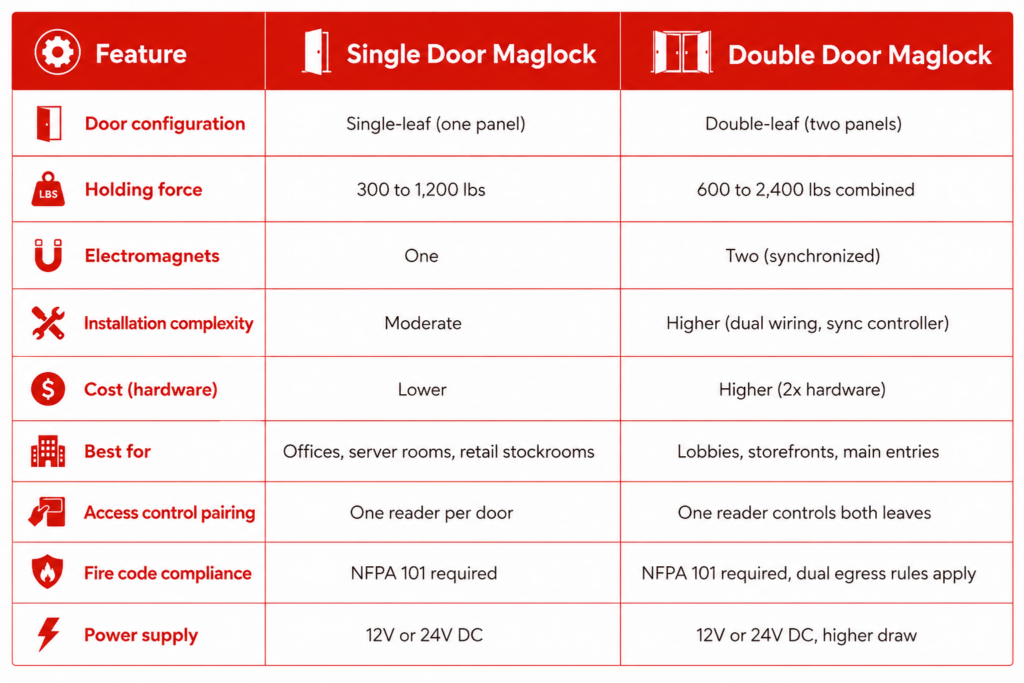
This comparison makes it clear that neither option is universally better. The right choice depends entirely on your door configuration and traffic volume, not personal preference.
Holding Force: How Much Do You Actually Need?
One of the most common questions facility managers ask is how much holding force is enough for their doors. The answer depends on three factors: door size, traffic volume, and security classification.
600 lb Holding Force
This is sufficient for most interior commercial doors. Interior office doors, server room entries, stockroom doors, and exam rooms in healthcare settings typically fall into this category. A 600 lb maglock provides strong resistance against forced entry while staying within a reasonable power consumption profile.
1,200 lb Holding Force
Exterior-facing doors, high-security areas, and facilities with elevated threat profiles require the higher holding force. Financial institutions, law firm document rooms, data center entry points, and government facility doors commonly use 1,200 lb electromagnetic locks. For double door configurations at main building entries, 1,200 lb per leaf (2,400 lb total) is the standard specification.
The International Door Association notes that holding force selection should account for wind load resistance in addition to security requirements, particularly for exterior doors in Texas where seasonal weather creates significant door stress.
A common mistake is undersizing the maglock on a high-traffic double-leaf entry. When a door experiences frequent impact from foot traffic, a 600 lb per leaf system may register nuisance releases. For main building entries in Dallas commercial facilities, 1,200 lb per leaf is the standard recommendation.
Door Type and Material: Does It Affect Your Maglock Choice?
Yes, significantly. The door material determines which bracket system is required and whether standard installation applies or a custom configuration is needed.
Glass Doors
Both single and double door maglocks can be installed on frameless or framed glass doors using specialized glass door brackets. These mounting systems clamp to the glass panel without drilling through it, which preserves the door’s structural integrity. Maglocks for glass doors are among the most common installations Security in DFW performs across Dallas office buildings and retail spaces.
For double-leaf glass entries, a slim-profile double door maglock with low-profile brackets is the appropriate choice. The aesthetics matter as much as the function in lobby glass door applications.
Wooden Doors
Standard L-bracket or Z-bracket configurations work well on wooden door frames. Single door wooden entry points are straightforward installations. The primary consideration is ensuring the armature plate is flush-mounted so the magnetic contact surface is maximized for full holding force.
Metal Hollow-Core Doors
Metal doors are the easiest to work with for maglock installations. The frame provides a rigid mounting surface and the door face accepts the armature plate without flex. Both single and double configurations perform consistently on metal doors.
Integrating Maglocks with Access Control Systems in Dallas
A maglock by itself is a locking device. The real power comes from pairing it with an access control system installation in Dallas that controls when and for whom the lock releases.
Both single and double door maglocks integrate with:
Keycard and key fob readers — The most common integration in commercial Dallas buildings. Employees tap a credential against a reader mounted beside the door, the access controller validates the credential, and the maglock releases.
Keypad entry systems — PIN-based access, suitable for areas where individual tracking is less critical but controlled access is still required.
Biometric readers — Fingerprint and facial recognition systems that pair with maglocks for high-security applications including server rooms, executive suites, and financial record storage areas.
Mobile credential systems — Smartphone-based access via Bluetooth or NFC, increasingly common in modern Dallas commercial facilities.
Intercoms and video intercoms — Visitor management systems where a receptionist or staff member remotely releases the maglock via a buzzer or app.
Do Double Door Maglocks Need Two Separate Readers?
No. This is one of the most common misconceptions about double door installations. A single reader mounted on one side of the door frame controls both leaves through the synchronized controller. When the credential is accepted, both electromagnetic units receive the release signal simultaneously. You do not pay for two readers, two access panels, or two credential licenses just because you have two door leaves.
For exit control on double-leaf doors, a single request-to-exit motion sensor or a wide-coverage push-to-exit button covers both leaves. The wiring runs from one sensor to the access controller, which triggers both locks together.
This is why commercial access control installation in Dallas paired with double door maglocks is not twice the cost of a single door system. The access control hardware costs are nearly identical. The incremental cost is primarily in the second maglock unit and the synchronized wiring.
Security in DFW installs Hikvisionaccess control systems alongside both single and double door maglock configurations across Dallas commercial properties. Hikvision’s DS-K2600 series controllers support multi-door configurations with individual scheduling, credential management, and real-time audit logs accessible from a central dashboard.
Fire Code and NFPA 101 Compliance in Dallas, TX
Every commercial electromagnetic lock installation in Dallas must comply with NFPA 101, the Life Safety Code that governs egress and emergency exits in commercial buildings. Non-compliant installations create legal liability and fail building inspections.
What NFPA 101 Requires for Maglocks
Per NFPA 101 Section 7.2.1.6, electromagnetic locks used on egress doors must meet the following conditions:
The lock must release upon activation of the building fire alarm system. This requires a direct connection between the maglock power supply and the fire alarm panel.
The lock must release upon loss of power to the lock. This is the inherent fail-safe behavior of all properly wired maglocks.
The lock must release through a means of egress that does not require a key, tool, or special knowledge. This means a request-to-exit button or motion sensor must be present on the egress side.
For double door maglock installations, both leaves must release simultaneously upon any triggering condition. A system where one leaf releases before the other is non-compliant and creates an egress bottleneck.
ADA Compliance Considerations
The Americans with Disabilities Act requires that locking hardware on accessible routes does not require tight grasping, pinching, or twisting of the wrist to operate. Maglocks paired with push-button or motion sensor exit controls satisfy this requirement. Keypad or biometric entry on the exterior side must be positioned at ADA-compliant heights between 15 and 48 inches above the floor.
The U.S. Access Board provides specific guidance on accessible route hardware requirements that apply to commercial maglock installations in Texas.
Real-World Examples: Which Dallas Businesses Use Each Setup
Understanding the theory is useful. Seeing how real facility types apply these systems makes the decision much clearer.
Single Door Maglock Installations in Dallas
A legal firm in Uptown Dallas securing its document storage room from the main office uses a single door 1,200 lb maglock paired with a keycard reader. Partners and authorized staff badge in, the maglock releases, and access activity is logged for compliance records.
A dental practice in Plano uses single door 600 lb maglocks on all exam room doors that require controlled access between waiting areas and treatment zones. The system allows front desk staff to control access remotely while patients cannot enter unsupervised areas.
A data center in Carrollton secures each server room entry with a single door 1,200 lb maglock integrated with biometric readers. Every access attempt is logged with a timestamp and employee ID for security audits.
Double Door Maglock Installations in Dallas
A mid-rise office building in Downtown Dallas uses double door 1,200 lb per leaf maglocks on the main lobby entry. The building management controls access hours, locks the entry after business hours automatically, and tracks visitor credential use through a Hikvision access panel.
A restaurant in Deep Ellum with a double-leaf main entrance uses 600 lb per leaf maglocks paired with an intercom system. During business hours the lock releases on a timer. After hours, staff enter via keycard and the entry is fully secured.
An apartment complex in Frisco uses double door maglocks on the lobby entry, the fitness center, and the pool access gate. Residents use mobile credentials via smartphone to enter all three areas, with the management office maintaining full access logs.
Also Read: How Long Do Maglocks Last? What Dallas Businesses Should Expect?
Installation Process: What to Expect from a Professional Installer in DFW
Whether you are installing a single or double door maglock, the process follows the same professional sequence when performed by a licensed installer.
Site assessment is the starting point. A qualified technician evaluates the door frame material, hinge configuration, door weight, and available power routing before specifying hardware.
Hardware specification comes next. The technician selects the appropriate maglock model, bracket type, power supply rating, and access control components for your specific door and security requirements.
Magnet and armature mounting follows the hardware selection. On single door configurations this is a one-bracket installation. On double door setups, both leaves are measured and mounted simultaneously to ensure perfect alignment between both magnets and both armature plates.
Power supply wiring is run through the door frame or ceiling void to the dedicated power supply. Voltage is tested with a multimeter before the lock is activated.
Access control device connection links the reader, keypad, or biometric unit to the access controller, which in turn connects to the maglock power supply.
Fire alarm integration connects the power supply to the building’s fire alarm panel so the lock releases automatically during alarm activation.
Final testing covers lock engagement at full holding force, power outage simulation to verify fail-safe release, credential testing through the reader, and request-to-exit button function verification.
Most single door maglock installations in Dallas take between two and four hours. Double door installations with synchronized wiring typically take three to six hours depending on frame complexity and distance from the power supply location.
Cost Factors: What Affects the Price of Maglock Installation in Dallas?
Maglock installation cost in Dallas varies based on several factors that are specific to each project.
Lock model and holding force directly affects hardware cost. A 600 lb single door maglock costs less than a 1,200 lb double door synchronized system.
Door material and bracket requirements add variable cost. Glass doors with frameless bracket systems require more specialized hardware than standard metal frame installations.
Wiring distance and complexity affects labor time. A maglock installed directly below a ceiling-mounted power supply costs less to wire than one requiring a 50-foot conduit run through finished walls.
Access control integration adds to the total cost but also adds significant value. A standalone maglock with only a push-button exit provides basic security. A maglock integrated with a keycard reader, access controller, and cloud-based management software provides enterprise-grade security and full audit trail capability.
Number of doors affects per-door cost. Multi-door installations across a building share overhead costs and often reduce the per-door price compared to single-door projects.
Security in DFW provides free on-site assessments for all maglock installation projects in Dallas, TX so you receive an accurate quote before any work begins. Most installations are completed the same day.
Conclusion: Get the Right Maglock for Your Dallas Facility
The choice between a single door and double door maglock comes down to one core question: how many door leaves are you securing?
Single-leaf doors need a single door maglock. Double-leaf doors need a synchronized double door system. Installing the wrong configuration creates security gaps, fire code violations, and wasted investment.
Beyond the physical configuration, the access control integration, holding force specification, and fire code compliance requirements are where professional expertise makes the difference. An improperly installed maglock in a Dallas commercial building is not just an inconvenience; it is a liability.
Security in DFW has installed electromagnetic locks for commercial facilities across Dallas, Plano, Frisco, Fort Worth, Carrollton, and the wider DFW area. Our licensed technicians assess your door type, traffic volume, and security requirements before recommending any hardware. Most projects are completed the same day with zero disruption to your operations.
FAQs
What is the main difference between a single door and double door maglock?
A single door maglock uses one electromagnet to secure a single-leaf door. A double door maglock uses two synchronized electromagnets to secure a double-leaf door where both panels must release together. The choice depends entirely on your door configuration.
Can a single door maglock be used on a double-leaf entry?
No. A single maglock on one leaf of a double-door entry leaves the second leaf unsecured. Both leaves must be independently locked and synchronized for the entry to be properly secured. Using a single maglock on a double-leaf door also creates fire code violations.
How much holding force does a commercial double door maglock need?
For most commercial double-leaf entries in Dallas, 600 lbs per leaf (1,200 lbs total) is appropriate for standard lobbies and storefronts. High-security or exterior-facing entries should use 1,200 lbs per leaf (2,400 lbs total).
Do double door maglocks require two separate access control readers?
No. A single reader controls both leaves through a synchronized controller. The reader triggers a simultaneous release of both electromagnetic units when a valid credential is presented.
Are maglocks compliant with fire codes in Texas?
Yes, when properly installed. NFPA 101 requires maglocks to release upon fire alarm activation, power loss, and through a request-to-exit device on the egress side. Installations by licensed contractors ensure code compliance.
How long does it take to install a double door maglock in Dallas?
A professional double door maglock installation typically takes three to six hours depending on door frame complexity, wiring distance, and access control integration requirements.
Can maglocks be installed on glass doors?
Yes. Both single and double door maglocks are installed on glass doors using specialized glass door mounting brackets that clamp to the glass without drilling through it. This is a common installation type in Dallas office buildings and retail spaces.
What happens to a double door maglock during a power outage?
Both electromagnetic units release simultaneously when power is cut because maglocks are fail-safe devices. If backup power is required to maintain security during outages, an uninterruptible power supply (UPS) is integrated into the system.
Can I integrate my maglock with my existing access control system?
In most cases yes. Standard maglocks operate on 12V or 24V DC and interface with access controllers from all major brands including Hikvision, HID, Brivo, and Avigilon. A qualified installer will confirm compatibility during the site assessment.
Which maglock setup is better for an office lobby with high foot traffic in Dallas?
A double door maglock with 1,200 lb per leaf holding force, integrated with a keycard or mobile credential reader, is the standard recommendation for high-traffic office lobby entries in Dallas. It provides the holding force, synchronized release, and access control audit capability that high-volume entries require.
Our Service Area
- Anna
- Ardmore
- Aubrey
- Bridgeport
- Briar
- Bonham
- Caddo Mills
- Carrollton
- Celina
- Commerce
- Corinth
- Denton
- Keller
- Justin
- Emory
- Farmersville
- Forney
- Fort Worth
- Frisco
- Gainesville
- Granbury
- Lantana
- Lewisville
- Lavon
- Little Elm
- McKinney
- Murphy
- Nevada
- Northlake
- Pilot Point
- Plano
- Princeton
- Quinlan
- Rhome
- Rockwall
- Royse
- Sachse
- Saginaw
- Sanger
- Sherman
- Sulphur Springs
- Sunnyvale
- Terrell
- Van Alstyne
- Prosper
- Wylie
- Weatherford