-
 Sep 11, 2026
Is a Door Access Control System Helpful for Businesses?
For many businesses, controlling who can enter the building is just as important as protecting the property with security cameras or alarms. Traditional keys can become difficult to manage as a company grows, employees change roles, or multiple areas require different levels of access.
A door access control security system gives businesses a more practical way to manage entry. Instead of relying only on physical keys, businesses can use key cards, key fobs, PINs, mobile credentials, or biometric identification to control access to specific doors.
But is access control actually helpful for a business? In most commercial environments, it can improve security, simplify access management, and provide better visibility into who is entering restricted areas.
What Is a Door Access Control System?
A door access control system is an electronic security solution that controls who can enter a building, room, or restricted area.
Instead of giving employees traditional keys, a business can assign individual credentials such as:
- Key cards or access badges
- Key fobs
- PIN codes
- Smartphone or mobile credentials
- Fingerprint or other biometric credentials
The system can then determine whether a person is authorized to enter a specific door and, depending on the setup, record the access event.
For example, an employee may have permission to enter the main office and their department but not the server room or inventory area. This level of control is one reason commercial door access control systems are increasingly used in offices, warehouses, healthcare facilities, retail businesses, and other commercial properties.
How Does a Door Access Control System Work?
A typical system has several components that work together.
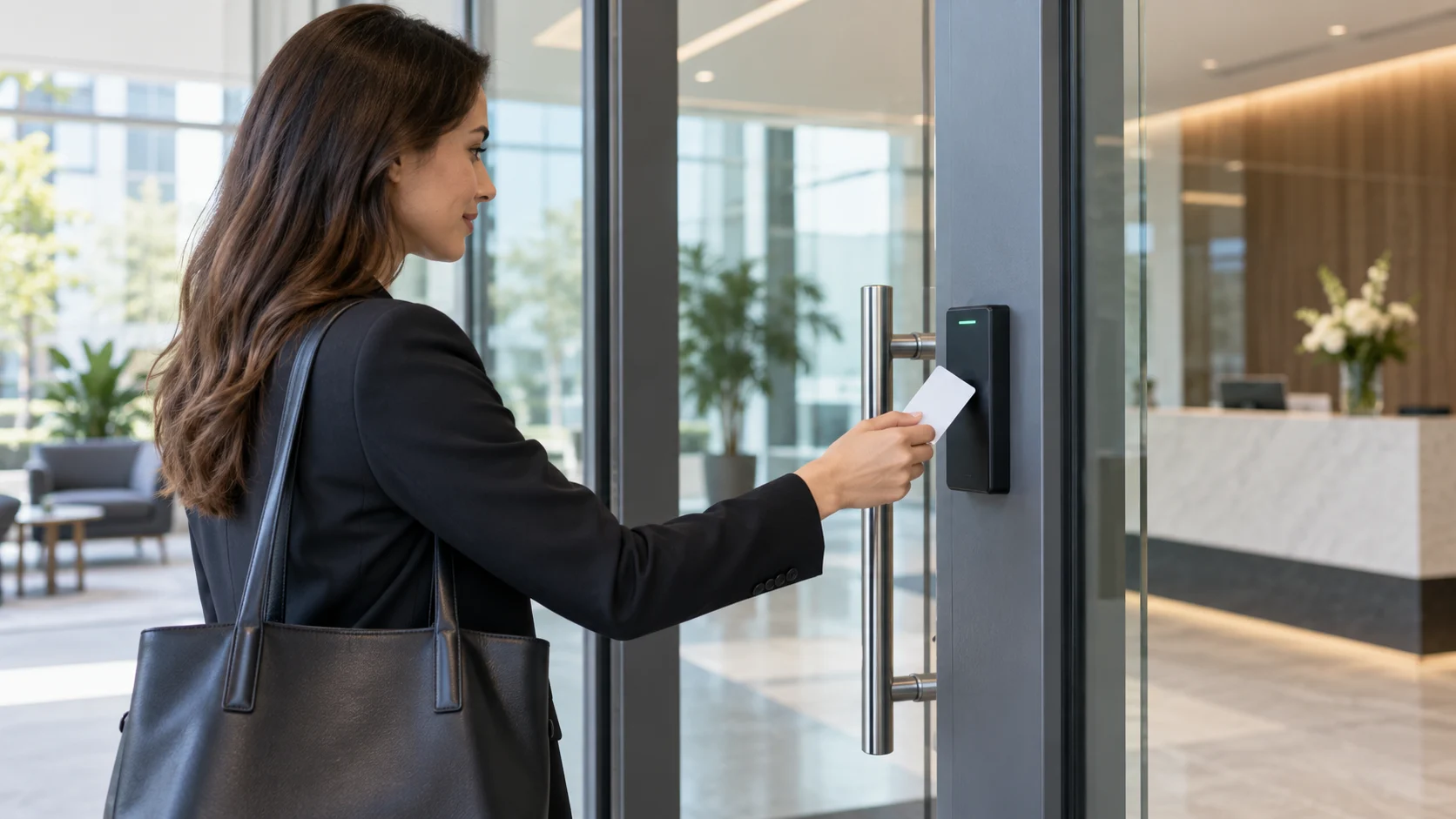
First, an employee presents a credential to a reader. The credential could be a key card, fob, PIN, smartphone, or biometric identifier.
The access control system checks that credential against the permissions configured by the administrator. If the person is authorized, the electronic locking hardware releases and allows entry. If access is not authorized, the door remains secured.
Many modern systems can also record access activity. This can help businesses determine when a particular credential was used and identify unusual or unauthorized access attempts.
Depending on the system, access permissions can also be assigned according to employees, departments, doors, schedules, and security requirements.
7 Benefits of Door Access Control for Businesses
1. Control Who Can Enter
The biggest advantage is better control over building access. Businesses can determine which employees, contractors, or visitors can enter specific areas.
This is especially useful for restricted spaces such as server rooms, offices, storage areas, records rooms, and inventory locations.
2. Reduce the Problems Caused by Lost Keys
Physical keys can be lost, copied, or never returned when an employee leaves.
With electronic credentials, businesses can deactivate a lost card or fob without necessarily changing the locks. This makes access management easier and can reduce the inconvenience associated with traditional keys.
3. Manage Employee Access More Easily
Businesses frequently hire new employees, change employee responsibilities, and terminate access when someone leaves.
With door access control systems for business, administrators can assign or remove permissions electronically. Access can also be customized depending on the employee’s role.
For example, an employee might have access to the building during business hours while a manager may have extended access to additional areas.
4. Create an Access Record
Many systems maintain records of access events. This gives business owners and facility managers greater visibility into building entry.
An access record can be useful when investigating a security incident or reviewing activity around restricted areas.
5. Protect Sensitive Areas
Not every employee needs access to every part of a business.
Access control can create separate security zones within a property. A company could restrict access to financial records, IT equipment, inventory, pharmaceutical storage, or other sensitive areas.
6. Improve Convenience
Modern access control does not have to mean carrying a large set of keys.
Employees can use cards, fobs, mobile credentials, or other approved methods to enter the building. Some systems also allow authorized administrators to manage access remotely.
7. Integrate With Other Security Systems
Access control can become even more useful when integrated with other security technologies.
For example, businesses can combine access control with security cameras to provide additional visibility around secured doors. An access event and corresponding video footage can help provide a clearer picture of what happened during a security incident.
Which Businesses Can Benefit From Door Access Control?
Almost any business with controlled entry can benefit from access control, but it can be especially useful for:
- Office buildings
- Warehouses and distribution centers
- Manufacturing facilities
- Retail businesses
- Healthcare facilities
- Schools and educational facilities
- Financial businesses
- Construction offices
- Multi-tenant commercial properties
- Professional offices
Businesses with multiple entrances, restricted areas, many employees, or frequent employee turnover may see particularly strong benefits.
Is Access Control Better Than Traditional Locks?
For many commercial businesses, yes, but the right solution depends on the property’s security requirements and budget.
Traditional locks are simple and can work well for low-risk applications. However, they generally do not provide the same level of control, access management, or visibility as an electronic system.
With traditional keys, businesses have to manage physical copies. If a key is lost or an employee leaves without returning it, the business may need to replace or rekey the lock.
With an electronic access control system, credentials can usually be added, changed, or deactivated without distributing physical keys.
The goal is not simply to replace a lock with electronics. A properly designed system should match the building, doors, users, security risks, and daily operations.
What Should Businesses Consider Before Installation?
Before choosing a system, businesses should consider the number of doors, number of users, security requirements, existing door hardware, preferred credentials, and whether they need remote management or integration with security cameras.
Professional planning is important because not every access control system is suitable for every commercial door.
A site assessment can help determine the appropriate readers, electronic locks, controllers, power requirements, cabling, software, and user permissions.
Professional Door Access Control System Installation in Dallas
If your business is still relying on traditional keys or an outdated entry system, upgrading to a modern door access control system installation can provide better control over who enters your property.
Security In DFW provides commercial access control solutions for businesses throughout Dallas-Fort Worth. Systems can be designed around your building, number of doors, employee access requirements, and overall security goals.
Whether you need access control for an office, warehouse, retail location, healthcare facility, or another commercial property, a professional assessment can help identify the right solution.
Contact Security In DFW to discuss your business security requirements and schedule a professional access control assessment in Dallas-Fort Worth.
Frequently Asked Questions (FAQs)
Our Service Area
- Anna
- Ardmore
- Aubrey
- Bridgeport
- Briar
- Bonham
- Caddo Mills
- Carrollton
- Celina
- Commerce
- Corinth
- Denton
- Keller
- Justin
- Emory
- Farmersville
- Forney
- Fort Worth
- Frisco
- Gainesville
- Granbury
- Lantana
- Lewisville
- Lavon
- Little Elm
- McKinney
- Murphy
- Nevada
- Northlake
- Pilot Point
- Plano
- Princeton
- Quinlan
- Rhome
- Rockwall
- Royse
- Sachse
- Saginaw
- Sanger
- Sherman
- Sulphur Springs
- Sunnyvale
- Terrell
- Van Alstyne
- Prosper
- Wylie
- Weatherford