-
 Sep 1, 2026
What are commercial access control systems? A complete guide
A secure business needs to control more than just the front entrance. Employees, contractors, visitors, customers, and vendors may need access to different areas of a commercial property. A commercial access control system gives businesses a way to manage these entry points electronically and decide who can access specific areas.
Unlike traditional keys, modern access control can use key cards, key fobs, PINs, mobile credentials, or biometric identification. Businesses can assign permissions based on employees, departments, locations, schedules, and security requirements.
Access control can be used in offices, warehouses, retail stores, healthcare facilities, manufacturing facilities, schools, and other commercial properties. When properly designed and installed, it can improve physical security while making access management easier for business owners and facility managers.
How Do Commercial Access Control Systems Work?
A commercial access control system uses several components to verify a person’s credentials before allowing access through a secured door.
The process typically works as follows:
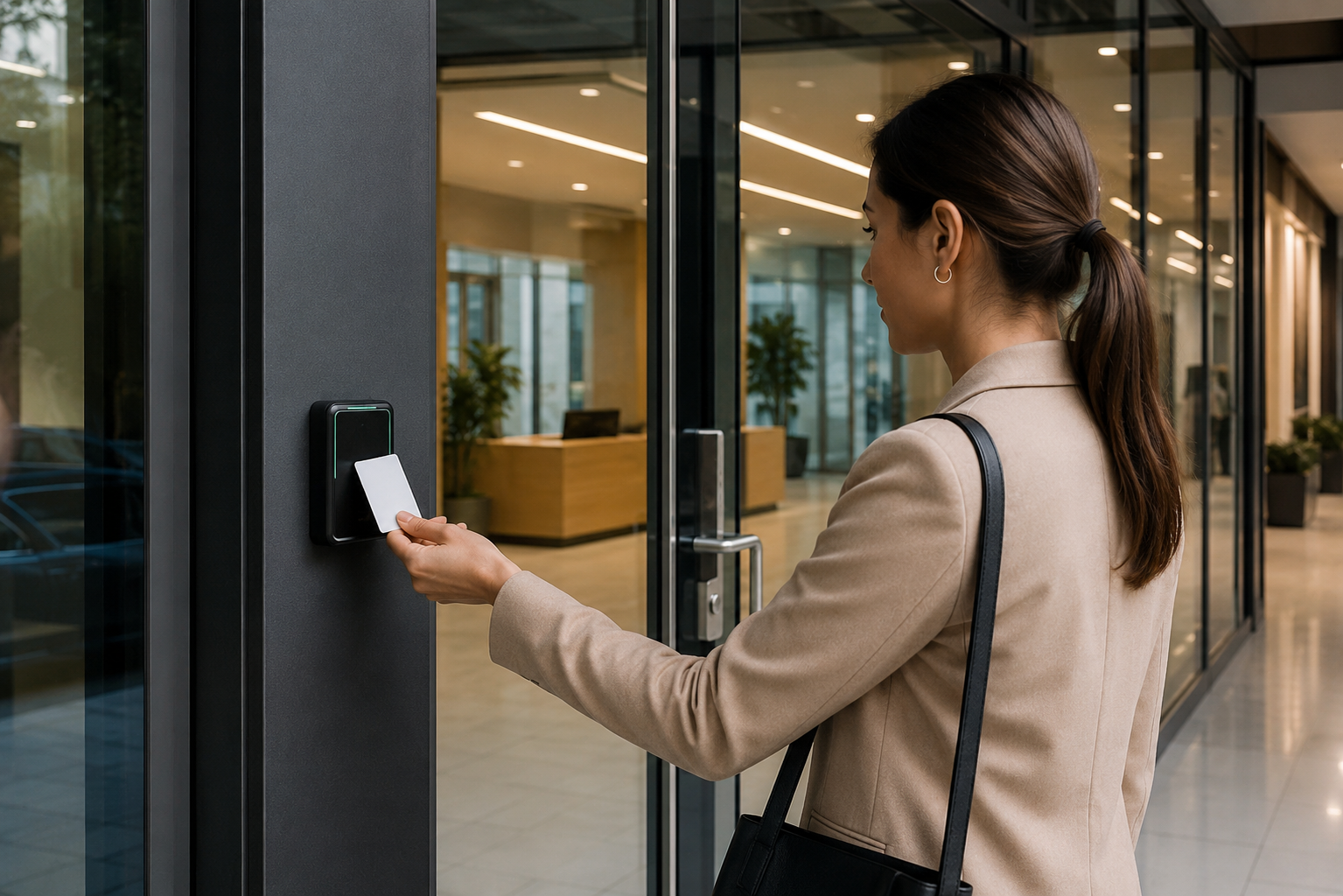
- A user presents a credential: The employee uses a key card, fob, PIN, mobile device, fingerprint, or another approved credential.
- The reader receives the information: A card reader, keypad, or biometric reader identifies the credential.
- The system verifies access: The access controller checks whether the user has permission to enter that particular area.
- The door responds: If access is authorized, the electronic lock releases. If permission is not available, the door remains secured.
- The activity can be recorded: Depending on the system, access events can be stored for administrative and security purposes.
Administrators can typically add users, remove former employees, change permissions, and establish access schedules through the system’s management platform.
Types of Commercial Access Control Systems
Businesses have several access control options. The right technology depends on the property’s layout, number of users, security requirements, and budget.
Key Card and Key Fob Access
Key cards and fobs are common in commercial environments. Employees receive individual credentials that can be assigned specific access permissions. Lost credentials can generally be deactivated without replacing every door lock.
PIN-Based Access Control
Keypad systems require users to enter an authorized PIN. They can be suitable for offices, storage rooms, utility areas, and other locations where businesses want controlled access without issuing physical credentials.
Mobile Access Control
Mobile systems allow employees to use smartphones as digital credentials. This can reduce the need for physical cards and provide businesses with another convenient way to manage access.
Biometric Access Control
Biometric systems can use fingerprints, facial recognition, or other biometric characteristics to verify identity. They are often considered for locations or areas requiring a higher level of access control.
Cloud-Based Access Control
Cloud-based systems provide access management through an online platform. Depending on the solution, administrators may be able to manage users, permissions, doors, and access activity remotely.
Benefits of Access Control for Businesses
Installing access control can provide several security and operational benefits.
- Controlled entry: Businesses can restrict access to specific rooms, buildings, floors, or other areas instead of providing every employee with unrestricted access.
- Better credential management: Access credentials can be added, changed, or deactivated as employees and responsibilities change.
- Protection of restricted areas: Server rooms, inventory areas, financial offices, equipment rooms, and other sensitive locations can have additional access restrictions.
- Access activity records: Many systems record access events, providing useful information about when credentials were used at secured entry points.
- Reduced dependence on traditional keys: Lost keys can create security concerns and may require lock replacement. Electronic credentials can often be disabled individually.
- Flexible permissions: Access can be assigned based on employees, departments, doors, and schedules.
- Scalability: Commercial access control systems can be designed for a single door or expanded to cover multiple entrances and locations as a business grows.
Which Businesses Need Commercial Access Control?
Access control can benefit almost any organization that needs to control physical entry. It is particularly useful for businesses with sensitive information, valuable inventory, restricted areas, or multiple employees.
Common applications include:
- Office buildings: Restrict access to employee areas, executive offices, conference rooms, and server rooms.
- Warehouses: Control entry to storage and inventory areas.
- Retail stores: Protect stockrooms, offices, and employee-only areas.
- Healthcare facilities: Restrict access to medication, records, equipment, and staff areas.
- Manufacturing facilities: Control access to production areas, equipment, and restricted zones.
- Educational facilities: Manage access to classrooms, administrative offices, and other controlled areas.
- Financial businesses: Protect sensitive records, equipment, and employee-only spaces.
The system can be configured according to the property’s specific security requirements rather than applying the same access permissions to everyone.
Access Control vs. Traditional Locks
Traditional locks can provide a basic level of physical security, but they offer limited control over individual users. A key generally does not identify who is using it or provide an easy way to change access permissions.
Access control provides greater flexibility. Individual credentials can be assigned to employees, and permissions can be modified without changing the entire locking system.
For example, if an employee leaves a company, their access credential can be deactivated. With traditional keys, a business may need to collect the key or consider changing the lock if there is concern that the key could still be used.
Traditional locks can still have a role in commercial security. However, businesses with multiple employees, restricted areas, or changing access requirements may benefit from an electronic access control solution.
Integrating Access Control With Security Cameras
Access control becomes even more useful when integrated with video surveillance. Combining access control with security cameras can provide businesses with both entry information and visual verification.
For example, when someone uses a credential at a secured entrance, the associated security camera can provide video of the activity. This can help security personnel or managers better understand what happened at a particular access point.
An integrated security solution can help businesses monitor:
- Main entrances
- Employee entrances
- Parking areas
- Restricted rooms
- Warehouses
- Server rooms
- Loading areas
The specific integration capabilities depend on the access control and video surveillance systems being used. A professional security installer can evaluate compatibility and design the systems to work together effectively.
Choosing the Right Commercial Access Control System
The best commercial access control systems are not necessarily the most expensive. The right solution depends on the property’s security needs and how access needs to be managed.
Before selecting a system, consider:
- Number of doors requiring access control
- Number of employees and users
- Type of credentials required
- Areas that need restricted access
- Need for remote management
- Access schedules and permission levels
- Integration with security cameras
- Existing door hardware and locks
- Future expansion requirements
- System maintenance and support
Businesses should also consider scalability. A system that works for a small office today may need to support additional doors, employees, or locations in the future.
A professional assessment can help identify vulnerable entry points and determine which access control technology is appropriate for the property.
Professional Commercial Access Control Installation
The performance of an access control system depends on more than selecting the right equipment. Proper installation, configuration, and integration are also important.
Professional commercial access control installation typically begins with an assessment of the property’s entrances, doors, restricted areas, existing security equipment, and business requirements.
An installer can then recommend appropriate readers, electronic locks, controllers, credentials, and management software. Proper configuration can help ensure that employees receive the correct access permissions while sensitive areas remain restricted.
Professional installation can also help integrate access control with security cameras and other commercial security systems.
For businesses in the Dallas-Fort Worth area, Security in DFW provides commercial security solutions designed around individual property requirements. A professional assessment can help determine the appropriate access control configuration for your business.
Frequently Asked Questions (FAQs)
Our Service Area
- Anna
- Ardmore
- Aubrey
- Bridgeport
- Briar
- Bonham
- Caddo Mills
- Carrollton
- Celina
- Commerce
- Corinth
- Denton
- Keller
- Justin
- Emory
- Farmersville
- Forney
- Fort Worth
- Frisco
- Gainesville
- Granbury
- Lantana
- Lewisville
- Lavon
- Little Elm
- McKinney
- Murphy
- Nevada
- Northlake
- Pilot Point
- Plano
- Princeton
- Quinlan
- Rhome
- Rockwall
- Royse
- Sachse
- Saginaw
- Sanger
- Sherman
- Sulphur Springs
- Sunnyvale
- Terrell
- Van Alstyne
- Prosper
- Wylie
- Weatherford