-
 Sep 22, 2026
What are the advantages & disadvantages of maglocks
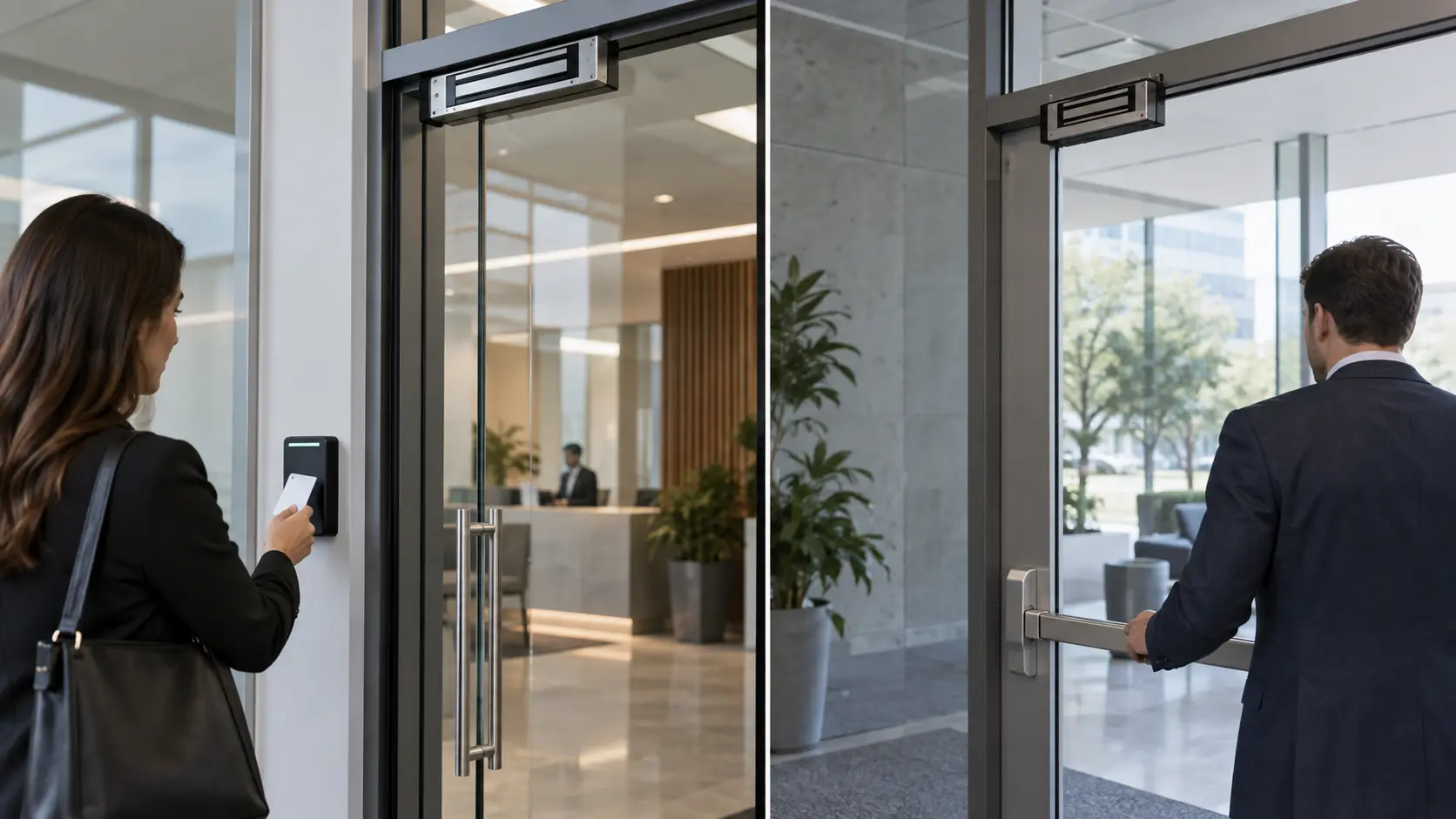
Maglocks, also called magnetic locks or electromagnetic locks, are widely used in commercial access control systems to control who can enter a building, office, restricted area, or other secured space. Unlike a traditional lock, a maglock uses an electromagnet and an armature plate to hold a door closed.
They can be a practical solution for businesses that need controlled entry, especially when working with glass doors or openings where modifying the existing door hardware is difficult. However, maglocks also have limitations that should be considered before installation.
Understanding the advantages and disadvantages of maglocks can help you determine whether they are the right choice for your business.
How Does a Mag Lock Work?
A typical magnetic lock has two main components: an electromagnetic lock mounted to the door frame and a metal armature plate mounted to the door.
When electrical power is supplied, the electromagnet creates a magnetic field that pulls the armature plate against it and holds the door closed. When an authorized user presents a credential, enters a code, or activates another approved access method, the access control system interrupts power to the lock, allowing the door to open.
Most maglocks are fail-safe, meaning they release when power is removed. This characteristic can be important for emergency egress, but it also means the system needs to be designed properly around the building’s life-safety requirements.
Advantages of Maglocks
1. Works Well With Many Door Types
One of the biggest advantages of maglocks is their flexibility. Because the lock does not depend on a conventional latch mechanism, they can be useful on doors where installing an electric strike is difficult. This is one reason maglocks for doors are commonly considered for commercial offices, controlled interior areas, and certain glass-door applications.
2. Good Option for Glass Doors
A maglock for glass door applications can be particularly useful because many glass doors have limited space for conventional locking hardware. Depending on the door and frame construction, a properly selected maglock can be mounted without requiring the same type of frame preparation associated with some electric strikes. Glass door installations still require the correct mounting hardware and professional assessment.
3. Strong Holding Force
Maglocks are available with different holding-force ratings. Commercial models commonly provide substantial holding force when properly installed on a suitable door and frame. However, the rated holding force should not be the only factor considered. The strength of the mounting surface, door construction, alignment, and installation all affect real-world performance.
4. Simple Electronic Access Integration
Maglocks can work with many access control components, including card readers, keypads, key fobs, mobile credentials, request-to-exit devices, and other access control equipment. This makes them useful when a business wants to replace traditional keys with controlled electronic entry.
5. Fewer Moving Mechanical Parts
A magnetic lock does not rely on a traditional mechanical latch inside the lock itself to hold the door closed. This can make the hardware attractive for certain high-traffic applications where repeated mechanical movement may be a concern.
Disadvantages of Maglocks
Maglocks are not the right solution for every commercial door. There are several important limitations to consider.
1. They Depend on Continuous Power
A maglock needs power to remain locked. If power is interrupted, the electromagnetic force is removed and the door releases. That can be beneficial for emergency egress, but it can also create a security concern during an unexpected power outage if the access control system does not have appropriate backup and life-safety provisions.
2. They Are Fail-Safe
Unlike some electric strikes that can be configured for fail-secure operation, standard maglocks release when power is lost. For that reason, a business should not select a maglock simply because it has a high holding-force rating. The door’s purpose, emergency exit requirements, fire alarm integration, and applicable building and life-safety requirements all need to be considered.
3. Additional Exit Hardware May Be Required
A maglock can secure a door from unauthorized entry, but people inside the building still need a safe and compliant way to exit. Depending on the application, the installation may require request-to-exit devices, emergency release hardware, fire alarm integration, or other components. These requirements should be evaluated by a qualified access control professional rather than treated as a simple lock replacement.
4. The Hardware Is Visible
Because maglocks are commonly surface-mounted on the door and frame, the hardware can be more noticeable than an electric strike installed inside the frame. For businesses where appearance is a major concern, an electric strike or another electrified locking solution may provide a cleaner installation when the door is compatible.
Maglocks vs. Electric Strikes
Maglocks and electric strikes both provide electronic access control, but they secure the door differently.
A maglock uses an electromagnetic force between the lock and armature plate. An electric strike works with the door’s existing mechanical latch and releases that latch electronically when access is authorized.
|
Feature |
Maglock |
Electric Strike |
|
Locking method |
Electromagnetic force |
Releases mechanical latch |
|
Power loss |
Typically unlocks |
Can be fail-safe or fail-secure |
|
Glass door applications |
Often suitable with proper hardware |
May be difficult depending on door/frame |
|
Visible hardware |
Usually yes |
Often less visible |
|
Existing latch required |
No |
Yes |
|
Installation |
Often surface-mounted |
May require frame preparation |
The important point is that there is no universal winner. The correct choice depends on the door, frame, existing hardware, security requirements, egress conditions, and how the opening needs to behave during a power failure.
What Is Right for Your Business?
A maglock may be worth considering if your business has:
- Glass or frameless doors
- Interior restricted-access areas
- High-traffic controlled entry points
- Doors where installing a conventional electric strike is difficult
- A need to integrate locking hardware with an electronic access control system
An electric strike or another electrified locking solution may make more sense when the door already has compatible mechanical hardware or when maintaining a locked condition during power loss is an important requirement.
Before choosing a maglock for door applications, have the complete door opening evaluated. The right solution depends on more than the lock itself.
Professional Commercial Access Control Installation in Dallas
Choosing the right hardware is only part of a successful access control installation. The lock, access reader, door hardware, power supply, exit devices, wiring, and safety components all need to work together.
Security In DFW provides commercial access control installation in Dallas and across the DFW area, helping businesses select and install access control solutions based on their doors, security requirements, and daily operations.
If you’re considering maglock door installation, glass-door access control, or an upgrade from traditional locks, a professional assessment can help determine which solution fits your building.
Contact Security In DFW to discuss your access control requirements and schedule an on-site assessment. Call (469) 225-3031.
Our Service Area
- Anna
- Ardmore
- Aubrey
- Bridgeport
- Briar
- Bonham
- Caddo Mills
- Carrollton
- Celina
- Commerce
- Corinth
- Denton
- Keller
- Justin
- Emory
- Farmersville
- Forney
- Fort Worth
- Frisco
- Gainesville
- Granbury
- Lantana
- Lewisville
- Lavon
- Little Elm
- McKinney
- Murphy
- Nevada
- Northlake
- Pilot Point
- Plano
- Princeton
- Quinlan
- Rhome
- Rockwall
- Royse
- Sachse
- Saginaw
- Sanger
- Sherman
- Sulphur Springs
- Sunnyvale
- Terrell
- Van Alstyne
- Prosper
- Wylie
- Weatherford