-
 Aug 26, 2025
Why Dallas Businesses Need Commercial Building Access Control Systems in 2025?
Security is not only a lock and a key; it is the basis of trust, efficiency, and peace of mind in your business. Whether it’s securing confidential information, controlling foot traffic, or helping your business minimize risk, today’s commercial access control systems are the behind-the-scenes champions of security and efficiency.
Consider such a scenario: you are outside the office, but a delivery is at the door. In the proper system, you get temporary access on a swipe, no fob losses, no key exchanges, no logistics hassles. That is the power of selecting the correct access control solution.
This blog will address five important categories of systems, in both staple versions and cloud-based innovations, and the real-world advantages, decision-making principles, and how you can use these systems to grow your security with confidence.
What Is a Commercial Access Control System?
A commercial access control system is not merely a high-tech lock. It’s a security provision that identifies and manages who can or cannot access your business premises, certain rooms, or even online platforms. These systems rely on the use of more modern ways of granting or rejecting access than traditional keys, including card keys, fobs, mobile phone applications, or biometrics.
Their functionality is the ultimate power. Front desk operations are easier, cloud-based access allows you to restrict access remotely, delivery passes allow couriers to remain efficient and not jeopardize security, and scalable designs allow the system to expand as your business expands. Advanced capabilities like audit logs, visitor management, and even video integration take these systems far beyond just door locks to intelligent security networks.
Why Businesses Need Smarter Access Control
Let’s hold for a minute. Thinking about threats to your business, you might imagine cyberattacks or phishing emails. Yet those dangers are real, but the physical world is equally susceptible.
Old-fashioned locks and keys? They can be lost, duplicated, or stolen
Employee key cards? They are cheaply cloned using online tools.
Even simple PIN codes? They may be shared, guessed, or leaked.
The Fact is, commercial access control systems do more than door security. They protect your peace of mind, your employees, and your reputation.
And this is why enterprises are upgrading.
Finding the Right Commercial Access System
The process of selecting the right system begins with assessing your needs and prioritizing what really matters:
- Front desk functionality: Does your company depend on reception personnel in order to control the flow of visitors? Choose a system that provides a live camera view, verification of visitors, and calls to facilitate the work of the reception.
- Cloud-based control: Avoid on-site servers and experience remote accessibility, automatic updates, and simple scalability, which are most suitable in contemporary businesses.
- Delivery or Visitor Passes: Businesses may have regular packages and guests, and time-limited PIN-based systems or access using QR codes allow easy entry without sacrificing security.
- Scalability: When you expand your business, add locations, and more users, and you need to redefine access zones, this is when you need to make sure that it can be changed without a complete reimplementation.
- Advanced features: Seek out multi-factor authentication, audit trail, and real-time alerting, the essentials for high-security or regulated environments.
With such prioritization, you will not only acquire an access control system that is functional but also future-proof and efficient.
The 5 Types of Commercial Access Control Systems for Businesses
Security that fits your business cannot be a one-size-fits-all. Various industries and buildings require various solutions. The following are the five most popular commercial access control systems that industries are using today:
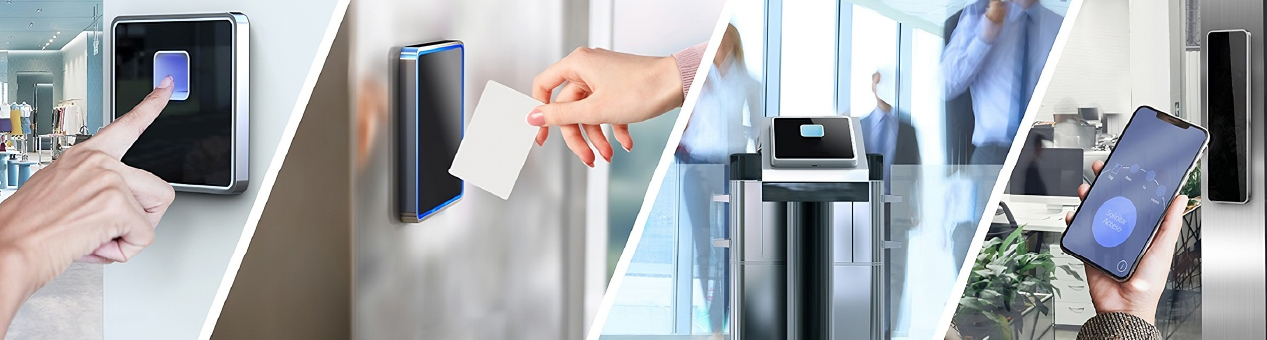
Key Card Access Control
Imagine the scenario: Sarah, a small business owner in Dallas, used to give her 15 employees physical keys. Whenever a person would leave the company, it was necessary to rekey the entire office, which was a waste of time, stress, and money.
And after that, she changed to a key card commercial access control system.
At this time, when an employee leaves the company, she clicks one button to deactivate their card.
Why it works:
- Workers are issued a mini card or fob that they use in order to gain access after swiping or tapping.
- Lost cards? Revocable with ease.
- Ideal in an office, coworking, and mid-size businesses.
Best for: Companies that desire an inexpensive upgrade of the traditional keys without delving into biometrics.
Biometric Access Control
Fingerprints are not identical. Each iris is unique. This is why biometric commercial access control systems are referred to as the gold standard in current security.
How it works: The system scans a physical characteristic that is unique-fingerprint, face, or iris scan, and allows entry.
The reasons why businesses love it:
- Not possible to copy or replicate.
- Correct audit trail of each entry.
- No more misplaced or forgotten cards & codes.
Real story: One warehouse in Dallas was robbed on numerous occasions due to the stolen access cards that were replicated to gain access without being noticed. The problem was eliminated at once after switching to fingerprint scanners.
Best for: Secure facilities such as healthcare facilities, research facilities, or finance institutions.
Mobile Access Control
Consider this: what is the one thing that no one leaves their place without? Their phone.
Mobile commercial access control systems transform mobile devices into digital keys. Doors are unlocked by simply using an app or a Bluetooth / NFC tap by the employees.
The reason behind this trend:
- Touchless entry is quick and sanitized.
- Remote control: Access can be allowed or blocked immediately by the admins.
- No more physical cards to lose or duplicate.
Imagine this: Your business manager is on vacation when he/she receives an emergency call that a contractor is urgently required to have temporary access. She opens the app and makes temporary access instead of driving back; the problem is solved.
Best for: Technologically advanced enterprises, work environments that are agile, and companies with remote workers.
Keypad & PIN Access Systems
This ancient, but modernized modern solution: keypad commercial access control systems.
Doors are unlocked by entering a code on an electronic keypad.
The reasons why businesses prefer it:
- Easy and economical.
- No need for cards or devices.
- It is possible to alter the code immediately.
The catch: PINs are shareable or guessable, hence so many companies combine them with dual-factor authentication (such as a PIN and a fingerprint).
Best for: Small business or budget-focused firm requiring more than standard locks.
Cloud-Based Access Control Systems
It is the future of access management.
The cloud-based commercial access control system links all items, including doors, credentials, and client data, to a central unit through online connectivity.
What makes it effective:
- Manage multiple locations from one dashboard.
- Real-time warnings of malicious access.
- Simple interaction with HR systems, visitor management, and even video surveillance.
Scenario: A chain store of five stores in the Texas area can control all employee access remotely. A manager in Dallas can disable a lost access card in Houston in real time; they no longer need to visit the store.
Best for: Expanding companies, multi-location firms, and organisations seeking expansion.
How Does a Commercial Access Control System Work?
At its essence, an office access control system is straightforward: scan a credential, verify that it’s legitimate, and unlock the door if the user is authorized. However, behind the scenes, a number of components are cooperating to ensure that everything remains secure.
The five critical elements of most systems are as follows:
- Door Controller: The brain of the system. It makes decisions on whether to authorize or reject on the basis of stored credentials.
- Access Reader: The equipment the workers deal with (swiping a card, inserting a PIN, touching a phone).
- Access Credentials: What users show up to get access: cards, fobs, pins, biometrics, mobile apps.
- Commercial Electronic Door Lock: A Mechanism that unlocks the door physically or locks the door, such as electromagnetic or keyless locks.
- Software: The management system that handles permissions, monitors logs, and offers analytical capabilities. The most efficient software today is cloud-based, implying that you can operate it anywhere on the globe.
These five elements in harmony allow businesses to securely regulate access, and, at the same time, make operations easier.
Benefits of a Commercial Access Control System
What is the reason that so many businesses are switching? The advantages are quite difficult to overlook:
- Enhanced Security: Secures against intrusion and lowers the chances of theft.
- Convenience: There are no more missing keys, rekeying the lock, or any confusion in who can have access.
- Scalability: Add or delete users with ease as your team evolves.
- Audit Trails: Have complete visibility of access logs & possible security breaches.
- Remote Management: Control permissions anywhere and anytime, which is convenient in multi-location businesses.
In very simple words, commercial access control systems do not merely protect your building; they protect your peace of mind as well.
FAQ’s
How much does a commercial access control system cost?
The prices range extensively depending on the size of your facility and the type of system. A smaller keypad system can cost a few hundred dollars, and a larger cloud-based system can cost thousands.
What industries benefit most from access control?
All industries, such as healthcare and retail, can benefit. Nevertheless, companies dealing with sensitive data or products, such as law firms, technology firms, and warehouses, are most likely to take them into consideration.
Conclusion
In the modern world of business, where everything is dynamic, they need to safeguard their assets, staff, as well as reputation, and this is not an option. Conventional keys and locks are obsolete and provide little or no accountability. But with a commercial-grade access control system, you get smarter, scalable, and designed for the modern workplace security. Using biometric verification, cloud-based monitoring, and more, these solutions do more than lock doors; they open the door to confidence.
Are you willing to improve the security of your business? You can do it now. Do not wait until someone breaks in and emphasizes your weaknesses. Install a commercial access control system tailored to your needs and take charge of your security, protect what is important to you: your people, your property, and your peace of mind presently.
Our Service Area
- Anna
- Ardmore
- Aubrey
- Bridgeport
- Briar
- Bonham
- Caddo Mills
- Carrollton
- Celina
- Commerce
- Corinth
- Denton
- Keller
- Justin
- Emory
- Farmersville
- Forney
- Fort Worth
- Frisco
- Gainesville
- Granbury
- Lantana
- Lewisville
- Lavon
- Little Elm
- McKinney
- Murphy
- Nevada
- Northlake
- Pilot Point
- Plano
- Princeton
- Quinlan
- Rhome
- Rockwall
- Royse
- Sachse
- Saginaw
- Sanger
- Sherman
- Sulphur Springs
- Sunnyvale
- Terrell
- Van Alstyne
- Prosper
- Wylie
- Weatherford