-
 Mar 14, 2025
Access Control Installation Made Easy: A Comprehensive Guide & Free Checklist
Access Control Installation Made Easy: A Comprehensive Guide & Free Checklist
Security of a property is possible easily with access control systems as they are used to check and regulate access to a building. Modern security for businesses and organizations cannot function without them.
An Access Control System Installation is useful in the protection of buildings which limits the access of people who should not be there. It is useful in small offices as well as large companies to restrict entry and enhance security. An access control system is useful in the security of any office or facility that needs to be protected.
Access control systems increase security by restricting access to certain areas. Our guide, “Access Control Installation Made Easy” breaks down the installation process into easy-to-follow steps and comes with a free checklist that will help you get set up quickly and correctly for effective security.
Types of Access Control System Installation
Here are the different types of Access Control System Installation which can help to offer a secure and efficient way of controlling the entry and exit.
Door Locks (Maglocks & Electric Strike)
These locks are incredibly strong and secure. Maglocks for glass doors use powerful magnets to lock the doors, providing a seamless and durable security solution. Are you looking for the strongest and best Maglock For Commercial Doors?
Electric strike locks, which are designed for use with a buzzer or keycard system, enable you to allow access while still keeping the area secure. This is a great option for office space, retail space, and commercial space.
Biometric Access Control
This type of system uses fingerprints, and face or eye recognition to grant access. It is quite safe as it is based on the characteristics of every individual.
Card Reader
A keycard or a badge is presented to the reader to unlock the doors. This method is rather fast, quite simple, and is used quite often in offices and hotels.
Time-Keeping
Some access control systems are able to inform the management of the time of arrival and departure of employees or visitors. This is useful in most business organizations in order to have accurate records of employee’s working time.
Benefits of Access Control System Installation
Installing an Access Control System Installation enhances security, introduces intelligence, and boosts efficiency. Here are the key benefits:
Enhanced Security
Restricted access enables only authorized personnel to enter certain areas, preventing trespassing or unauthorized access. This is especially vital in businesses, data centers, and high-security environments. Access control also prevents unauthorized entry with security mechanisms like Card readers and biometrics.
Such systems can also provide a greater deal of safety against data breaches because they restrict access to sensitive and confidential areas and information, preventing possible cyber or physical threats.
Simplified Access Management
Businesses are provided with the ability to actively monitor and manage access permissions via a formally centralized system leading to more efficient security operations. Employees have easy access, using their keycards, biometrics, or mobile credentials rather than traditional keys that can be lost or duplicated.
Moreover, companies can quickly disable access for workers who leave or change jobs, reducing the need to rekey locks and maintain security moving forward.
Improved Operational Efficiency
One of the best advantages of Access Control System Installation is enhanced operational efficiency. By automating key management and enhancing physical security, these systems save businesses time and resources that would otherwise be spent on each of these setups. In addition, centralized management allows administrators to control and update access permissions in real-time over multiple sites.
As there is no need for conventional keys, employees no longer have to carry several keys to enter the building or feel at risk of losing them, enhancing both convenience and security.
Regulatory compliance
Not many people know this but security camera systems also get you regulatory compliance for your business. The security professionals during the installation ensure you comply with all the required standards.
Otherwise, you might risk your business facility to hefty fines or penalties, and can put you in legal trouble.
Cost & Energy Savings
Access control systems are a smart financial investment, providing savings both in terms of costs and energy. Plans begin at $995 making it a cost-effective solution for small to large companies. Additionally, because access control can tie in with smart building systems, energy savings can be realized when lights, HVAC (Heating, Ventilation, Air Conditioning), and other energy-hungry devices are only allowed to operate when and where necessary, lowering utility bills as a result.
Also Read: Access Control System Installation Cost Breakdown in 2025
Auditing and Compliance
Auditing and compliance with Access Control System Installation become much easier with improvements in both procedures. These advanced systems offer better auditing capabilities and can keep track of who comes and goes at all times with detailed access logs, a feature that’s critical to businesses of all types.
This ability is vital for security investigations and internal audits. Access control systems can also assist companies in fulfilling compliance requirements, as these systems ensure that security measures are in accordance with industry regulations and standards.
Also Read: Top Access Control Service Provider in DFW: Secure Your Business Today
Step-by-Step Guide to Access Control System Installation
From the assessment of security needs to regular maintenance, a successful Access Control System Installation has multiple steps. Each of these stages also ensures the system’s effectiveness, safety, and compliance with regulations. Here is a detailed description of each step:
Site Survey and Assessment
The first step of Access Control System Installation is site survey and assessment. High-risk areas, entry and exit points, and potential weaknesses are also identified in this process.
Security specialists take into consideration the design of the building, current infrastructure, and the number of workers or guests needing access.
Also, network strength for cloud-based systems, power sources for electronic locks, integration with CCTV cameras, etc. This helps to ensure that correct access control solutions are selected for the specific security needs of the location.
Planning and Design
After the completion of the site survey and assessment, the next step would be to plan and then design the system. This means detailing where access points are located, what type of authentication is needed (whether this includes Card readers, biometrics, or time-keeping), and what the access levels are for each user. Access Control System Installation must be well-planned to ensure that the organization is safe without causing unnecessary inconvenience to the personnel.
Choosing the Right Access Control System
Choosing the right system is an essential aspect of executing a successful Access Control System Installation. Businesses must consider a few factors such as account budget, scalability, compatibility with existing security infrastructure, as well as compliance with industry regulations (HIPAA). The correct system provides smooth security management, convenience in access control, and long-term viability. Here are some access control system types you might consider:
Biometrics
Biometric access control employs fingerprints, facial recognition, and iris scanning to provide access. Biometric data is unique to every person and cannot be simply duplicated, making it highly secure. This system is best suited for high-risk areas, such as government buildings and data centers.
Card Readers
Access control based on cards is one of the most popular methods used in offices, hotels, and educational institutions. RFID keycards are issued to employees or visitors to grant them access to authorized areas. They are cost-efficient, convenient, and can be integrated with other security systems.
Time-Keeping Systems
These are access control systems with a time-keeping feature that helps monitor employee working hours. They keep track of entry and exit times, thus being useful for workforce management, processing payroll, and compliance with labor law. Environments, where accurate time tracking is required, such as factories, corporate offices, and healthcare facilities, can utilize this type of access control.
Access Control System Installation Process
After choosing the system the next step is the actual Access Control System Installation. The second step is to establish the hardware and software required for optimal and secure access management. Tasks performed during installation include:
Install Electronic Door Locks, Card Readers, and Biometric Scanners
Access points are fitted with electronic locks, card readers, electric strikes for doors, or biometric authentication devices to provide controlled entry and exit. These devices are installed at specific points according to risk assessment and site survey.
Running Cabling and Wiring for Communication
The cabling and wiring for communication need to be run properly; this is essential for ensuring seamless communication between the access control panels (and locks, if applicable) and the central management system. For wired vs wireless access control systems, test for network connectivity reliability.
Install Centralized access control management software
The access control software is being pre-installed and configured to monitor, log, and manage access at a workspace. The software allows administrators to monitor access activity as it occurs, particularly keeping track of logs and integrating with alarm systems and CCTV.
User Permissions Configuration
Assigns access levels according to roles, departments, or security clearance. Administrators identify who has access to particular spaces and when restricting sensitive areas to authorized personnel.
Testing and Certification for Access Control System Installation
Once the Access Control System Installation is complete, it must undergo thorough testing and certification to verify the proper operation of the system and compliance issues with security regulations. Licensed for certified installation #B19875, Security in DFW ensures your access control is installed securely, code-compliant, and fully functional.
The testing process includes the following key points:
- Testing All Access Points: All door locks, biometric scanners, and card readers are tested and verified to lock and unlock as applicable. If any malfunctions are identified then it is our responsibility to correct them as soon as possible.
- Biometric and Card Reader Accuracy Check: The system is checked to ensure that it recognizes only authorized personnel and denies entry to unauthorized individuals. Authentication errors are resolved before deployment.
- Confirming Integration with Other Security Systems: The access control system is verified that it integrates flawlessly with surveillance cameras, alarm systems, and monitoring platforms.
- Auditing Security for Compliance: The system is audited against industry regulations like HIPAA, or other security compliances. Audit trails and access logs are reviewed so that the reporting is accurate.
Ongoing Maintenance for Access Control System Installation
The ongoing security and efficiency with compliance standards depend on regular maintenance practices. Regular maintenance enables you to lower the possibility of system breakdowns and security failures along with unauthorized system entries. Key maintenance tasks involve:
- Regular Software Updates:
Perfectly updating the system prevents all security vulnerabilities in the system, cyber threats, and possible hacking attempts. Updates improve performance and bring new features too.
- Regular Hardware Inspections:
Electronic locks, card readers, and biometric scanners need to be examined regularly for wear and tear. To keep the system reliable, faulty or outdated components are replaced.
- Log Review on Access:
Log review on access helps uncover any unusual activity, unauthorized attempts, and security threats. Frequent monitoring enables rapid response to suspicious events.
- User Access Management:
The credentials of employees should be handled precisely. This includes employee access credentials that should be updated when employees change jobs, roles, leave, or join.
Common Mistakes to Avoid in Access Control System Installation
The implementation of an Access Control System must proceed through precise planning as well as effective execution. Several installation errors lead to compromised security performance of systems. Malfunctions in Access Control installation arise from these main mistakes. So make sure to avoid these Mistakes During Access Control Installation:
- Poor Planning and Lack of Hardware Placements
Security gaps and operational inefficiencies will occur because of subpar access point placement when site surveys are not executed thoroughly. A well-established planning process allows organizations to select positions for their security devices which maximize their protective capabilities.
- Lack of Backup for Access Control Data
System failures along with cyber incidents that result in access control data loss create operational disruptions.
- Neglecting Cybersecurity Risks in Cloud Systems
Cloud-based access control depends on multiple security protocols which consist of encryption and multi-factor authentication and systematic system upgrade implementation.
Best Practices for Maintaining Your Access Control System Installation
Regular Maintenance for Access Control System Installation Degradation, outages, and interruptions are averted by adhering to best practices. Some key maintenance practices that are applicable are:
- Regular Software Updates and Firmware Patches
Updating the access control system’s software and firmware on a regular basis protects your system down the line from cyber threats, security vulnerabilities, and system malfunctions. When you update, sometimes you receive performance updates and security updates.
- Conduct Background Security Audits
Conducting background security audits will help to know how effective your system is working, you can obtain regulatory acts from the audits providing you additional piece of mind and helping you to spot any weaknesses or attempted breaches. Audits also ensure that this system is properly configured for current security needs.
- Employee Training on Access Protocol
Human errors resulting in a breach disaster can be avoided by training employees to use access controls correctly, understand security policies, and follow best practices. Training should include how to handle badges, report lost credentials, and identify potential security threats.
Conclusion
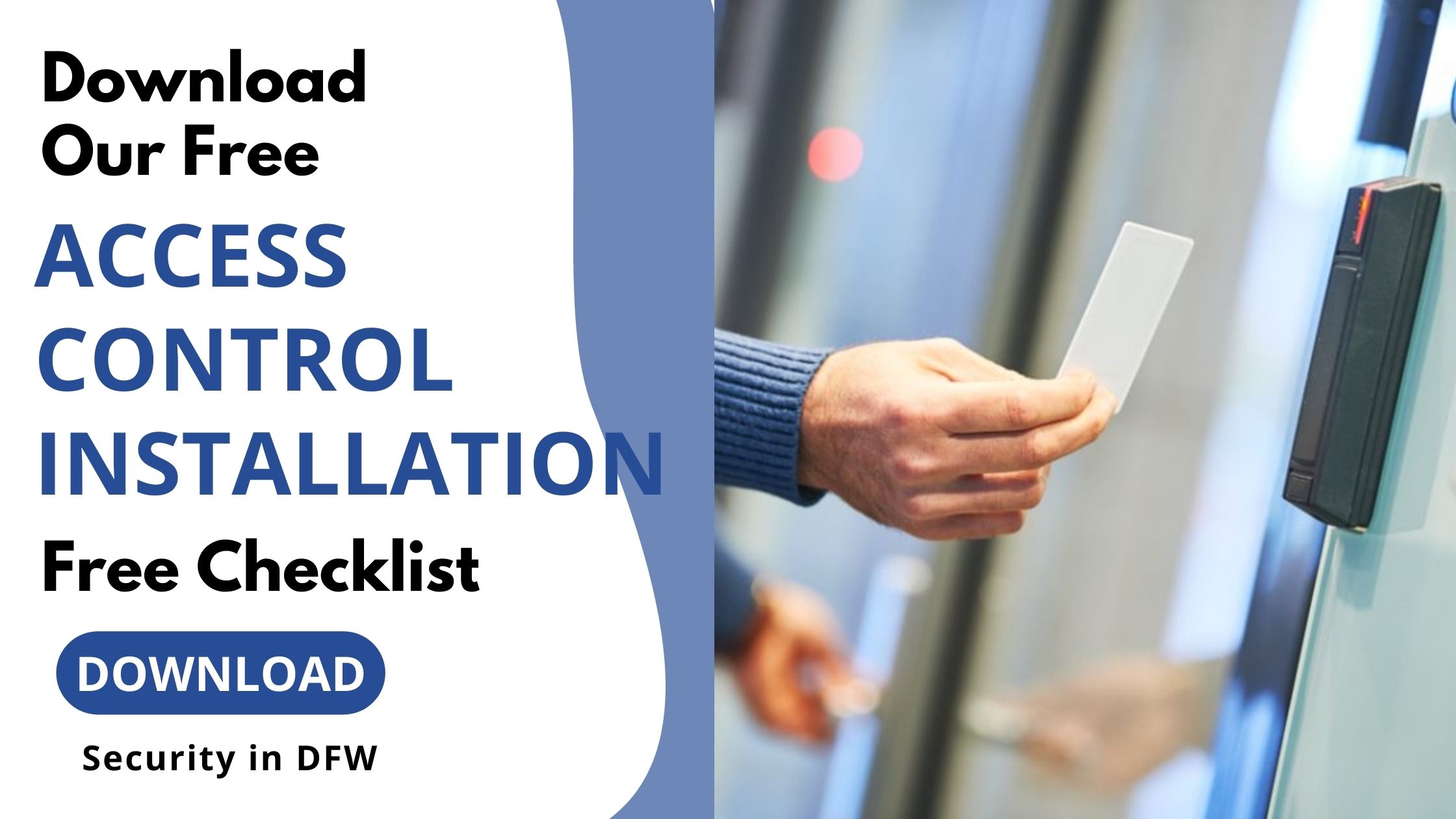
With a well-executed Access Control System Installation, the security can be heightened, access management can be streamlined, and operational efficiency can be enhanced. Each step, from site assessment through ongoing maintenance, ensures a reliable, secure system. The system is also kept effective by regular updates, security audits, and employee training. Download the free checklist to make installation easier and make sure you implement it properly.
Our Service Area
- Anna
- Ardmore
- Aubrey
- Bridgeport
- Briar
- Bonham
- Caddo Mills
- Carrollton
- Celina
- Commerce
- Corinth
- Denton
- Keller
- Justin
- Emory
- Farmersville
- Forney
- Fort Worth
- Frisco
- Gainesville
- Granbury
- Lantana
- Lewisville
- Lavon
- Little Elm
- McKinney
- Murphy
- Nevada
- Northlake
- Pilot Point
- Plano
- Princeton
- Quinlan
- Rhome
- Rockwall
- Royse
- Sachse
- Saginaw
- Sanger
- Sherman
- Sulphur Springs
- Sunnyvale
- Terrell
- Van Alstyne
- Prosper
- Wylie
- Weatherford