-
 May 12, 2026
Why Dallas Businesses Are Installing (LPR) Cameras in Parking Lots?
If you run a commercial property in Dallas and you still rely on manual security checks or paper permits in your parking lot, you are already behind. Property managers across the Dallas-Fort Worth metroplex have been quietly installing license plate recognition (LPR) cameras over the past few years, and the pace picked up significantly in 2024 and 2025.
This is not a trend driven by paranoia. It is a practical response to real problems: rising vehicle theft, retail crime spillover into parking areas, unauthorized vehicle dumping, and the sheer operational waste of managing parking manually. Dallas sits in one of the fastest-growing metro areas in the country, and with that growth comes increased vehicle traffic, higher-density commercial zones, and a greater need for smarter property management tools.
This guide covers what LPR technology actually does, why Dallas-area businesses across industries are adopting it, how it connects to your broader security camera and surveillance strategy, and what to look for when choosing a system. There are no gimmicks here, just a clear breakdown of what the data and real-world deployments show.
What Is License Plate Recognition (LPR) Technology?
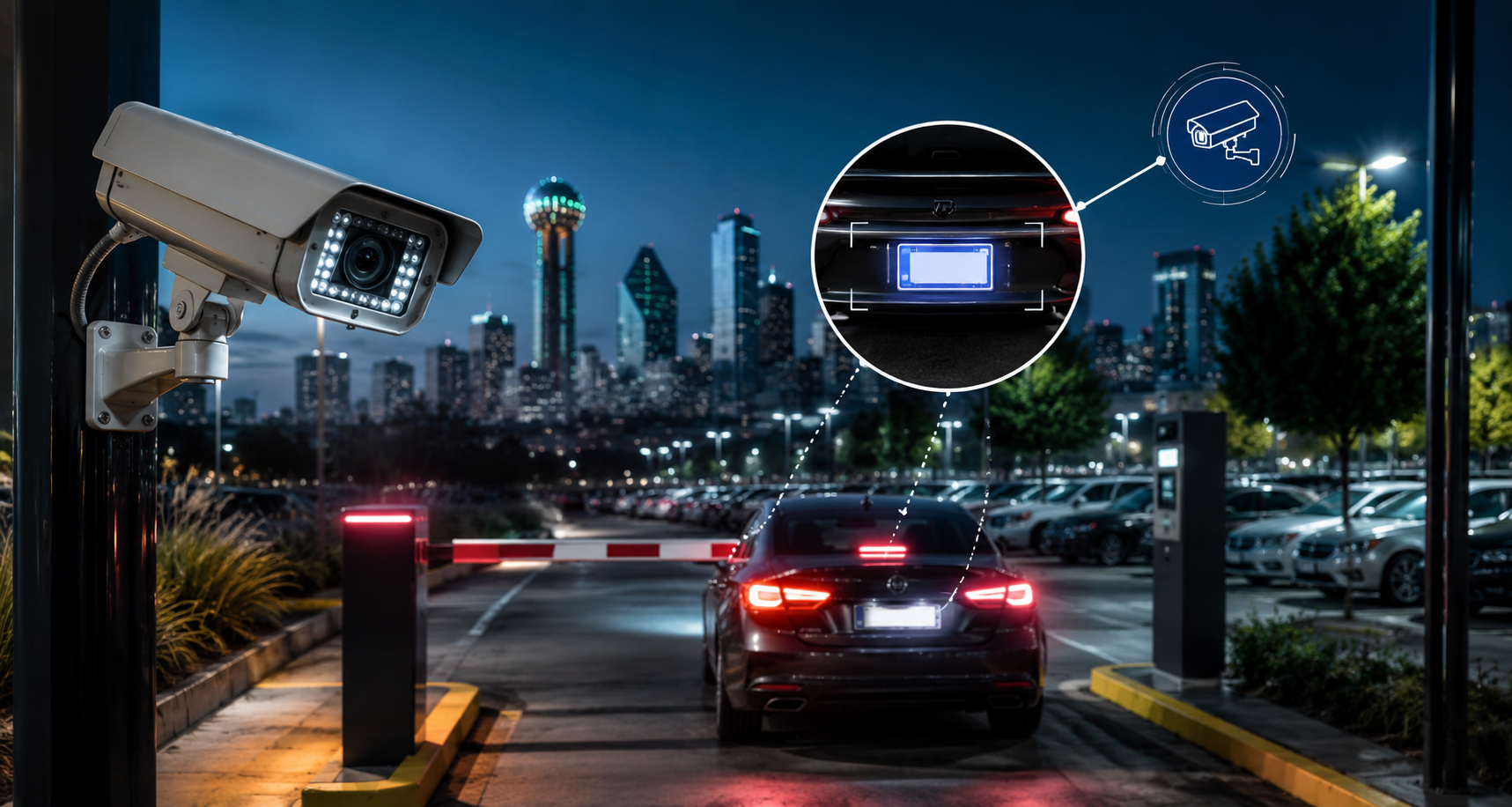
License plate recognition, also called automatic number plate recognition (ANPR), is a camera-based system that reads and records vehicle license plates in real time. The camera captures an image of a passing vehicle, and onboard software extracts the plate number using optical character recognition (OCR). That plate number is then checked against a database, logged with a timestamp, and can trigger automated actions — opening a gate, sending an alert, flagging a match.
Modern LPR cameras are not like the blurry parking lot cameras of ten years ago. Today’s systems use high-definition imaging, infrared illumination for nighttime reads, and machine-learning-based OCR that achieves accuracy rates above 95% even in adverse lighting or at vehicle speeds up to 100+ mph. For a commercial parking lot operating at normal traffic speeds, accuracy is effectively near-perfect under properly installed conditions.
How LPR Works Step by Step
- A vehicle enters the parking lot or facility entrance
- The LPR camera captures a clear image of the front or rear license plate
- The OCR engine extracts the plate number within milliseconds
- The system cross-references the plate against an internal whitelist or watchlist database
- An action is triggered: gate opens for authorized vehicles, alert fires for flagged plates, or the entry is logged silently for audit purposes
- All data including timestamp, camera ID, and plate image is stored in a secure database accessible to authorized staff
This happens in under two seconds. No guard needed. No manual log entry. No paper permit to check.
Why Dallas Specifically? The Local Context Matters
Dallas is not just any city. It is the third-largest metro in Texas and among the top ten largest in the United States. The DFW area added over 170,000 residents between 2022 and 2024 alone.
More residents means more commercial development, more retail centers, more mixed-use properties, and more vehicles competing for parking. Dallas also has specific property crime pressures worth noting:
Vehicle-related theft in Dallas has remained elevated. The Dallas Police Department has consistently reported auto theft among its top property crime categories, with catalytic converter theft spiking particularly in commercial parking areas where vehicles sit idle for extended hours. The parking lot is often the least monitored part of a commercial property, making it a preferred target.
Beyond theft, Dallas businesses deal with unauthorized parking from neighboring properties, permit fraud in shared parking structures, and in some retail-heavy corridors, vehicles associated with organized retail crime parking in adjacent lots before hitting stores. LPR cameras close all of these gaps simultaneously.
6 Reasons Dallas Businesses Are Installing LPR Cameras in Parking Lots
1. Automated Access Control Without the Guesswork
Traditional access control in parking relies on key fobs, gate codes, or staff-managed permit systems. All of these have failure points. Codes get shared. Fobs get lost or copied. Staff get busy and wave through vehicles they should not.
LPR-based access control eliminates those failure points. The system reads the plate and either grants or denies access based on a live database. You define who belongs employees, contractors, registered tenants and the system enforces that list without human involvement.
For high-traffic properties like office campuses, medical facilities, or retail centers with reserved parking, this is a significant upgrade. You get consistent enforcement every hour of every day, with a full timestamped log of every vehicle that entered or exited.
2. Parking Enforcement Without Hiring More Staff
Parking enforcement at commercial properties is a constant operational headache. Unauthorized vehicles take spots from customers or tenants. Permit violators frustrate tenants who pay for reserved spaces. Enforcing rules manually requires dedicated staff time that most property managers do not have.
An LPR parking enforcement system handles this automatically. The system identifies vehicles that do not belong, flags them in real time, and can alert a property manager or security team to act. Some integrations allow automated notifications to be sent directly to towing companies. The system also produces documentation plate number, entry time, timestamp photos that protects the property in any dispute.
3. Deterrence Before an Incident Happens
Criminals doing target reconnaissance recognize LPR cameras. A vehicle involved in prior theft or criminal activity that appears in a law enforcement watchlist will trigger an alert the moment it enters your lot. That is a deterrent before anything happens.
This is different from traditional cameras which capture footage for review after an incident. LPR systems are proactive. They work in real time. If a plate appears on a stolen vehicle database or your internal flagged list, security staff get notified while the vehicle is still on your property.
For Dallas retailers and office property managers dealing with repeat trespassers or harassment incidents, adding a flagged plate to the system turns the parking lot into an early warning system rather than just a recovery tool.
4. Evidence Quality That Actually Holds Up
Standard security cameras capture footage. But when an incident happens in a parking lot and you need to identify a suspect vehicle, standard CCTV footage often fails because the camera angle, lighting, or resolution cannot clearly read a plate. You end up with footage of a silver sedan, which is not useful.
LPR cameras are purpose-built to capture plates. The image quality is designed specifically for character recognition, which means the plate data is clear, timestamped, and legally usable. Dallas-area businesses have used LPR footage to support police investigations, insurance claims, and civil disputes with documentation that stands up because it identifies the vehicle specifically, not just generally.
5. Operational Intelligence Most Businesses Have Not Tapped Yet
Here is something the basic security camera market rarely talks about: LPR data is operational data, not just security data.
Every plate log is a data point. Over time, that data tells you when your parking lot peaks, which spaces fill first, how long average dwell times are, and whether your parking capacity is actually being used efficiently. Dallas retail centers and mixed-use properties are starting to use this data for layout decisions, lease negotiations with tenants, and even insurance premium discussions.
Property managers who understand that their security camera system is also an operational intelligence tool get significantly more value from the investment.
6. Integration With the Broader Security Ecosystem
A standalone LPR camera is useful. An LPR camera integrated with your access control system, your video management software (VMS), and your remote monitoring setup is an entirely different level of capability.
Modern LPR systems connect to gate controllers, alarm systems, intercoms, and cloud-based dashboards. When a flagged vehicle enters, the system can simultaneously log the plate, lock additional gates, send a push notification to the security manager’s phone, and save a clip to the cloud. That is a coordinated response in under three seconds with no human involvement.
For Dallas businesses that operate multiple locations across the metroplex, cloud-based LPR management means you can monitor all properties from a single dashboard. That is a scalable solution that grows with your portfolio.
Which Dallas Businesses Benefit Most From LPR Cameras?
Retail Centers and Shopping Strips
Dallas has some of the densest retail corridors in Texas, from Uptown to Plano to Irving. Retail parking lots face unauthorized long-term parking, theft, and organized retail crime. LPR cameras in retail parking identify repeat visitors who may be conducting surveillance before theft attempts, enforce time limits, and provide documentation for law enforcement cooperation.
Office Campuses and Corporate Parks
Employee-only parking, reserved executive spots, visitor management — all of these are cleaner and more enforceable with LPR-based access control. Large office parks like those in Las Colinas or Addison benefit particularly because they have multiple entry points and parking for hundreds of vehicles.
Medical Facilities and Healthcare Campuses
Patient-facing properties need a balance of open access and security. LPR systems allow medical offices to maintain accessible parking for patients while still logging every vehicle and flagging known problem plates. After-hours vehicle loitering around medical facilities is a documented security risk, and LPR provides 24/7 monitoring without requiring a guard on shift.
Apartment Communities and Multi-Family Properties
Dallas apartment complexes dealing with unauthorized parking in tenant lots, abandoned vehicles, and guest parking abuse find LPR to be the most cost-effective enforcement tool available. The system enforces rules without the property manager having to personally patrol or confront anyone.
Industrial Properties and Warehouses
Logistics facilities in areas like South Dallas or Garland have valuable equipment and inventory in and around their lots. License plate recognition cameras at industrial sites track vendor and contractor vehicles, enforce after-hours access policies, and create an audit trail that is useful for both security and operations.
How LPR Cameras Connect to Your Overall Commercial Security Strategy
Installing LPR cameras without thinking about how they fit your broader security architecture is a missed opportunity. The most effective deployments in Dallas treat LPR as one layer in a coordinated system that includes:
Video surveillance coverage — General area cameras provide contextual footage around the LPR capture point. When a flagged plate triggers an alert, the wider camera network shows you what is happening around that vehicle, not just the plate.
Access control integration — LPR feeds directly into gate and barrier control, removing the need for key pads or fobs at vehicle entry points.
Remote monitoring — For properties without on-site security staff, cloud-connected LPR allows off-site monitoring teams to view alerts, review footage, and coordinate responses in real time.
Alarm systems — After-hours LPR triggers can be tied to alarm panels, so an unauthorized vehicle entry outside business hours generates both a log entry and an alarm notification simultaneously.
This is why working with a full-service commercial security provider matters rather than buying a standalone LPR unit and hoping it integrates with your existing setup. Proper installation, camera placement, network configuration, and software integration require expertise that an IT generalist or a basic camera installer does not have.
What To Look for in an LPR System for Your Dallas Property
Not all LPR camera systems are equal. Here is what actually matters when evaluating options:
Read accuracy rate — Look for systems with documented accuracy above 95% in real-world conditions, not just lab environments. Ask vendors specifically about performance in low-light and rain, both common in Dallas weather patterns.
Database integration — Your LPR system needs to talk to your existing access control database or security management software. Closed systems that do not integrate cost you more in the long run.
Storage and retention — Texas commercial properties have different regulatory needs around footage retention depending on industry. Confirm the system supports your required retention period and that cloud storage is encrypted and access-controlled.
Scalability — If you have plans to expand your property portfolio in the DFW area, choose a platform that manages multiple sites from one interface.
Support and maintenance — LPR cameras are exposed to Texas heat, storms, and dust. Ask vendors about their maintenance SLAs and local support capacity in Dallas. Remote technical support from out of state is not the same as a local team that can respond in hours.
Privacy compliance — Texas law does not currently mandate specific LPR data retention limits for private properties, but industry best practice aligns with reasonable retention windows (30 to 90 days for non-flagged entries) and strict access controls on who can query the database. Following these practices protects your business from liability and builds tenant and customer trust.
The Cost Question: Is LPR Worth It for Dallas Commercial Properties?
The honest answer is that it depends on your property’s scale and current pain points. A small 20-space lot for a single-tenant building probably does not need a full LPR deployment. A 200-space retail parking lot with repeat unauthorized parking, tenant complaints, and documented theft incidents almost certainly does.
When property managers calculate the true cost of manual parking enforcement — staff time, disputes, tenant turnover related to parking frustrations, theft losses, and insurance claims — the math on LPR camera installation often works out within 18 to 24 months on a mid-size commercial property.
Hardware costs for commercial LPR entry points typically range from a few thousand dollars for a single-lane setup to tens of thousands for a full multi-entry deployment with integrated gate control and cloud management. Those numbers are general ranges; actual costs vary based on the number of lanes, existing infrastructure, integration complexity, and the vendor you choose.
What drives the ROI faster is not just theft prevention. It is the operational savings from eliminating manual permit management, reducing staff time on parking enforcement, and cutting down on the management overhead that unauthorized parking creates across your team.
LPR Cameras and Privacy: What Dallas Business Owners Need to Know
There is a real conversation happening nationally about license plate reader privacy. Stores like Walmart, Lowe’s, and others have faced pushback for deploying LPR systems that feed data to third-party networks.
For private commercial property operators in Dallas, the legal picture is clearer. You have a property right to monitor vehicles entering your private parking facility. Recording license plates of vehicles on your private property is lawful under Texas law. The ethical and practical considerations are:
Be transparent. Signage at lot entrances informing drivers that license plates are recorded is good practice. It is also a deterrent.
Do not share data with third parties without understanding the legal and reputational implications. Your LPR data is a business asset and a liability. Keep it internal and access-controlled.
Set reasonable retention policies. Storing years of plate data for a commercial parking lot serves no legitimate business purpose and creates unnecessary liability.
Do not use LPR data for purposes unrelated to parking management and security. The data should not be used for marketing, employment decisions, or any profiling unrelated to property security.
Handled properly, LPR in commercial parking is a reasonable, proportionate, and lawful security measure. Handled carelessly, it becomes a liability. Get the policy right before the system goes live.
Dallas businesses are not installing LPR cameras in parking lots because it is trendy. They are doing it because parking lots have become one of the most active problem zones on commercial properties, and traditional approaches to managing them are not working at the scale or consistency that modern operations require.
The technology has matured to a point where accuracy is high, integration is straightforward, and the operational benefits extend well beyond security. Whether you are managing a retail strip, an office campus, an apartment complex, or an industrial site in the DFW area, license plate recognition is a practical tool that pays for itself in enforcement, operations, and security outcomes.
If you are evaluating LPR for your property, start with a professional assessment of your lot layout, current pain points, and existing security infrastructure. The right system is not the most expensive one; it is the one that solves your specific problem, integrates cleanly with what you already have, and scales with your property portfolio over time.
Frequently Asked Questions
What does LPR stand for in parking lot security?
LPR stands for license plate recognition. It refers to camera-based systems that automatically read and record vehicle license plate numbers as vehicles enter or exit a parking facility.
Are LPR cameras legal for private businesses in Dallas, Texas?
Yes. Private businesses in Texas have the legal right to record license plates of vehicles entering their private property. Posting signage to notify drivers is a recommended best practice but is not legally required for private lots in Texas.
How accurate are LPR cameras in real-world conditions?
Commercial-grade LPR systems typically achieve accuracy rates above 95% under normal conditions. Factors like extreme glare, damaged plates, or mud-covered plates can affect reads. Proper camera placement and infrared lighting significantly improve accuracy.
Can LPR cameras work at night?
Yes. Modern LPR cameras use infrared illumination specifically designed for nighttime plate reads. They do not rely on ambient lighting, which makes them effective 24 hours a day.
How do LPR cameras help with parking enforcement in commercial lots?
The system identifies vehicles that are not on the authorized list and alerts property management staff. This documentation can include the plate number, entry time, and a photo timestamp, which supports towing or other enforcement actions.
Can LPR systems integrate with existing access control gates?
Yes. LPR systems can connect directly to gate controllers to automatically open or close barriers based on plate recognition results. This removes the need for key cards or codes at vehicle entry points.
How long is LPR footage and data typically stored?
Storage periods vary by system and property policy. Industry best practice for commercial properties is 30 to 90 days for standard plate logs. Data tied to flagged incidents is typically retained longer for evidentiary purposes.
What is the difference between LPR cameras and regular security cameras?
Standard security cameras capture general video footage. LPR cameras are purpose-built to capture license plate images with enough clarity for character recognition. They often use specialized lenses, shutter speeds, and infrared lighting that regular surveillance cameras do not have.
Do LPR systems work in high-traffic commercial parking lots?
Yes. LPR cameras are designed for high-volume environments and can process multiple vehicles in quick succession. Multi-lane configurations are available for high-traffic entry and exit points.
Can a small business in Dallas afford LPR cameras?
Entry-level single-lane LPR setups have become more accessible in recent years. For small properties with specific access control or enforcement needs, even a basic LPR entry point can deliver a meaningful return. A professional security assessment will clarify the right scope for your property size and budget.
Our Service Area
- Anna
- Ardmore
- Aubrey
- Bridgeport
- Briar
- Bonham
- Caddo Mills
- Carrollton
- Celina
- Commerce
- Corinth
- Denton
- Keller
- Justin
- Emory
- Farmersville
- Forney
- Fort Worth
- Frisco
- Gainesville
- Granbury
- Lantana
- Lewisville
- Lavon
- Little Elm
- McKinney
- Murphy
- Nevada
- Northlake
- Pilot Point
- Plano
- Princeton
- Quinlan
- Rhome
- Rockwall
- Royse
- Sachse
- Saginaw
- Sanger
- Sherman
- Sulphur Springs
- Sunnyvale
- Terrell
- Van Alstyne
- Prosper
- Wylie
- Weatherford