
 Jun 13, 2025
Top 5 Access Control Solutions for Commercial Buildings
It costs businesses more than $100,000 if an access point is breached, yet most commercial properties depend on old or unsecured systems. Now that offices and businesses are adopting hybrid work models, and as new security threats appear, organizations must make sure to consider physical access control.
Modern commercial places need more protection than just having lockable doors. Since work now involves employees coming into the office, working remotely, or working different schedules, protecting people, data, and assets is not easy. Businesses should use advanced technologies that allow them to prevent outsiders from entering and offer flexible access to authorized staff.
That is why having advanced access control in commercial buildings is so important. It enables business owners and facility managers to supervise, handle, and protect access points in real time, which increases safety and contributes to higher productivity.
Here, we will examine the top 5 proven access control solutions that companies can use in their commercial buildings in 2025. Whether you are managing an office building, a shop, or a multi-tenant building, these systems are going to assist you in increasing security, your daily operations, and future-proofing your property.
Why Access Control Is Critical for Commercial Buildings
Managing access to commercial buildings is essential to protect assets, employees, and sensitive information. These systems make it difficult for unauthorised people to enter and thereby decrease the chances of theft, violence at work, and data loss. Whether a place is large or small, has a few or many users, robust access control techniques help protect businesses and help them run more efficiently.
It is important for compliance with today’s standards, such as HIPAA, SOC 2, or PCI-DSS, that only necessary people can get into restricted zones or access certain data. With access control, business security can be assured by checking a person’s role, clearance level, or the time of day before permitting them to enter. They also capture activity and process it to develop reports proving their compliance when audits occur.
Because of hybrid work and flexible schedules, access control makes it easier for commercial buildings to keep their routines. Access Control allows staff members to enter and exit the building safely whenever they need, and their movements can be tracked for greater responsibility. Managers are able to understand occupancy patterns, so they can manage facility usage well and maintain proper security.
Top 5 Access Control Solutions for Commercial Buildings
Picking the correct access control system for commercial buildings is very important to safeguard assets, guide people’s movement, and follow regulations. Nowadays, businesses, whether big or small, require security and adaptability in their networks. In this blog, we will explain five access control methods that are both effective, easy to use, and can be scaled as needed for businesses.
Each option listed is special because of its advantages, for example, traditional RFID systems and smart IoT lock systems that can be managed remotely. No matter if you are an IT manager, a security consultant, or a facility owner, this guide assists you in choosing the system that is appropriate for your environment, budget, and users.
We should look at the top 5 access control systems helping to reshape commercial building security in the future.
Key Card & RFID Access Systems
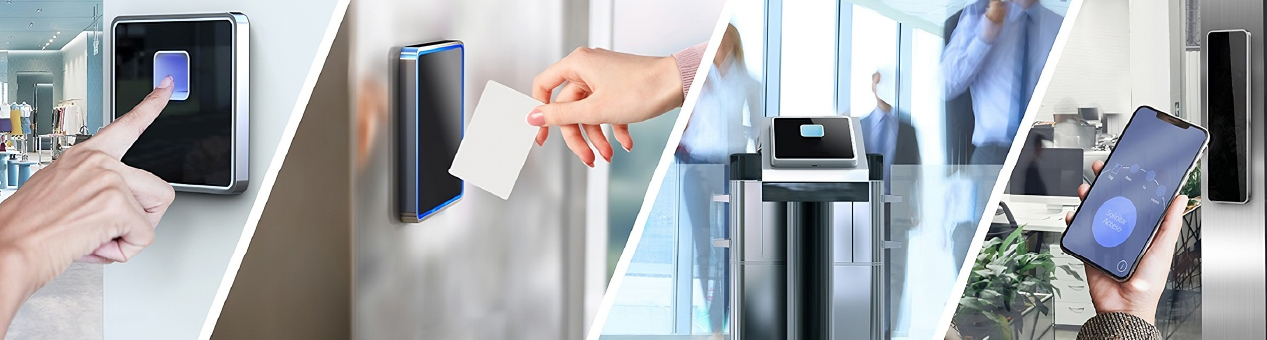
Both key card and RFID-based entry systems are still popular in access control for commercial buildings because of their easy use and ability to adjust for different needs. Office buildings, schools, universities, and hospitals use these systems to issue individual credentials and oversee people’s movements.
Good access control systems allow administrators to quickly set up or cancel access for anyone coming to the workplace. Entry logs are stored in these systems, making it possible for businesses to check their security activity at any time. Besides, RFID badges can be used without touching a surface, so you don’t have to worry about spreading germs.
Still, key card systems have a number of limitations. Cards can easily be replicated, misplaced, or shared, which makes the security weak. As businesses grow, organizing and using physical cards is more complicated. RFID, therefore, is one of the most popular and affordable ways to secure access to commercial buildings that want to be convenient and compliant.
Some organizations add video surveillance or door alarms to get better access oversight. In multi-tiered security systems, RFID technology forms a strong base that allows businesses to keep their properties safe without relying on complicated tech.
Mobile-Based Access Control Systems
Having smartphones as digital keys has become common in offices, which is a revolutionary approach to access control in businesses. You can use mobile apps that relate to Bluetooth, Wi-Fi, or NFC tech to make these doors open for you without a key or access card.
Because it is mobile-first, the system is useful for companies with hybrid or remote work settings that require employees to access things remotely. Using cloud dashboards, admins can change or remove permissions for users anytime and instantly. Using mobile credentials in multi-tenant office buildings allows unique access levels to be assigned to each user or organization, making the process simple for the manager.
The use of touchless entry helps support health by reducing areas people frequently touch and matches recent health guidelines. Using their phones, tenants can easily enter, use the elevators, or access their lockers without searching for key cards or thinking about security issues.
Although mobile banking is advantageous, it depends a lot on a reliable network and the willingness of users. Yet, many companies working towards being agile, adopting smart systems, and managing visitors better are adopting building access control solutions on mobile devices.
Biometric Access Control (Fingerprint, Facial Recognition)
Access control for commercial buildings is now easier with the help of cloud-based platforms that can be managed centrally from one place. Regardless of whether you manage offices, chains of stores, or workplaces for sharing, these platforms give you control over all entryways from one web-based system.
Using their dashboard, facility managers are able to configure users’ access, check live access logs, and integrate warning or surveillance systems, among other things. Therefore, they cut down on the use of on-site IT support and make it unnecessary to take care of local servers or software.
With subscription-based fees, businesses can use cloud services at a lower price and according to their needs. Companies purchase just what they require and can further upgrade when their needs change. Features like the ability to lock down remotely, assign temporary permissions, and connect to HR systems make things much easier for everyone.
Cloud access management is flexible enough that emergency access revocation occurs instantly, and the auditing process for compliance is simplified. For those wanting to improve the efficiency of their operations as they modernize, it offers valuable help. Because businesses are now mainly using digital solutions, cloud-based access control is a key element of smart, adaptable security for commercial buildings.
Smart Lock & IoT-Based Entry Systems
Using smart locks and access systems makes good sense for the budgets of small businesses and startups. Wi-Fi or Zigbee devices that are part of these systems help control access to commercial spaces, mainly smaller offices, branches, and co-working spaces.
Using only a few steps on a smartphone app, managers are able to provide access, get notified about building usage, and lock down the building from anywhere. Being able to work remotely is most useful for teams in different time zones or managing hybrid work schedules. Many smart locks provide a record of every access, so admins are aware of when and how doors have been visited.
Moreover, smart entry systems connect easily with things like lighting, climate control, and surveillance cameras, helping create an automated workplace. Employees or tenants are given access to the system when needed and don’t have to install additional hardware.
Such systems might not be suitable for major enterprises, but in situations that focus on being flexible, economical, and user-friendly, these systems are very helpful. Companies seeking to embrace technology without overspending can use smart locks for security in business sites.
How to Choose the Right Access Control System for Your Building
You should select the proper access control for commercial buildings based on your building’s size, the industry’s requirements, your available budget, and safety rules. Check if the system is able to work well with your current security solutions, such as security cameras and alarm systems. Make scalability and future improvements your main priority to guarantee the project continues to help in the long run. It is crucial to choose a reliable company that knows your organization and will handle all your setup, guidance, and support properly. A good access control system boosts security, improves access, and helps you follow required regulations.
Conclusion
The right access controls for commercial spaces minimize possible security issues, maximize productivity, and limit access only to people allowed in important areas. Due to higher risks and improvements in technology, companies need to actively secure their workers, assets, and information. The proper system not only provides security for your premises but also connects smoothly with your overall security systems.
Don’t leave your facility’s safety to chance. Our experts assess, design, and install customized access control solutions tailored to your needs.
Need help choosing the right access control solution? Contact our team today to schedule your on-site assessment or claim a free site security audit.
Our Service Area
- Anna
- Ardmore
- Aubrey
- Benbrook
- Bridgeport
- Briar
- Bonham
- Caddo Mills
- Carrollton
- Celina
- Commerce
- Corinth
- Denton
- Keller
- Justin
- Emory
- Farmersville
- Flower Mound
- Forney
- Fort Worth
- Frisco
- Gainesville
- Granbury
- Lantana
- Lewisville
- Lavon
- Little Elm
- McKinney
- Murphy
- Nevada
- Northlake
- Pilot Point
- Plano
- Princeton
- Quinlan
- Rhome
- Rockwall
- Royse
- Sachse
- Saginaw
- Sanger
- Sherman
- Sulphur Springs
- Sunnyvale
- Terrell
- Van Alstyne
- Prosper
- Wylie
- Weatherford
HOURS OF OPERATION
Monday through Friday :
9:00 am to 6:00 pm
After hours and weekend
CORPORATE OFFICE
1509 W Hebron Parkway
Suite Number 150
Carrollton, TX 75010