
 Jan 23, 2026
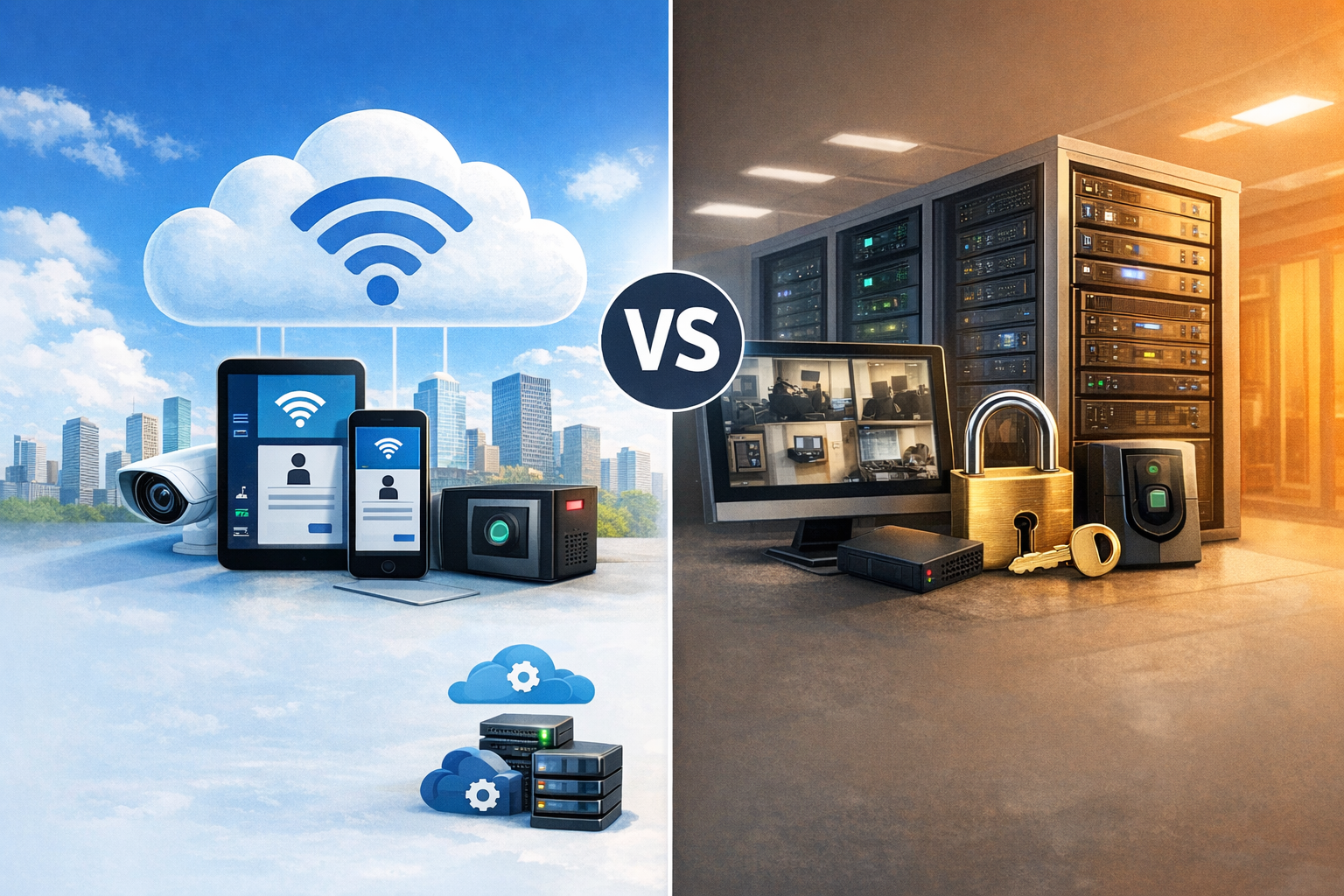
Cloud vs On-Premise Business Access Control Systems – Which Is Better for You?
Businesses spend thousands of dollars on locks, cards, cameras, and security software; however, intrusions continue to occur. The doors remain open, credentials are abused, and access logs are lost at the time when they are needed. It is no longer a question of whether you require access control, but how to manage it.
The current business access control systems are no longer just metal keys and simple keycards. The cloud-based access control and on-premise access control systems are two powerful options that dominate the market. Both of them guarantee security, visibility, and control, yet are used in very different ways.
Selecting the incorrect system may cost you time, money, and tranquility. Selecting the appropriate one can revolutionize the essence of protecting your people, assets, and data. This blog is going to discuss the functionality of cloud and on-premise access control systems, their advantages and disadvantages, practical examples, cost issues, scalability, safety, and how to determine the solution that better suits your business.
Understanding Business Access Control Systems
At their core, business access control systems regulate who can enter specific areas of a facility, when they can enter, and how their access is monitored. These systems replace traditional keys with smarter credentials such as key cards, mobile access, PINs, or biometrics.
The access control of the modern age does not simply open the door, but it provides accountability, audit trails, and real-time visibility throughout your whole facility. Cloud-based and on-premise access control systems are the two most widespread types of deployment models nowadays.
What Is a Cloud-Based Access Control System?
A cloud-based access control system is one in which data, access logs, and system management tools are stored in secure cloud servers as opposed to local computers. Administrators control permissions by use of a web dashboard or a mobile application.
This strategy has changed the way companies think regarding security. Your access control is no longer tied to a physical server room, so your access control becomes flexible, remote, and scalable.
Key Characteristics of Cloud-Based Systems
- Access managed from anywhere with an internet connection
- Automatic software updates and security patches
- Lower upfront hardware investment
- Seamless scalability as your business grows
Business access control systems based on clouds are particularly common in actively growing businesses, multi-location companies, and businesses that rely on flexibility.
What Is an On-Premise Access Control System?
An on-premise access control system runs entirely on servers located within your facility. All access data, logs, and configurations are stored locally and managed by internal IT teams or security providers.
In this conventional model, the companies are in full control of their infrastructure, which is important in any industry that has high compliance requirements or data sovereignty.
Key Characteristics of On-Premise Systems
- Data stored locally on physical servers
- Full internal control over configurations
- Higher upfront hardware and installation costs
- Requires in-house maintenance and updates
Enterprises that require complete ownership of their security environment tend to prefer on-premise business access control systems.
Cloud vs On-Premise: Feature-by-Feature Comparison
|
Feature |
Cloud-Based Access Control |
On-Premise Access Control |
|
Deployment |
Hosted on secure cloud servers |
Installed on local servers |
|
Upfront Cost |
Lower initial investment |
Higher hardware and setup cost |
|
Maintenance |
Vendor-managed updates |
Internal IT-managed |
|
Scalability |
Highly scalable |
Limited by hardware |
|
Remote Management |
Yes |
Limited or none |
|
Data Access |
Anywhere, anytime |
On-site only |
|
Disaster Recovery |
Built-in backups |
Manual backups required |
|
Ideal For |
SMBs, multi-location businesses |
Enterprises, compliance-heavy industries |
Security Concerns: Which Is Safer?
Security is a common issue that business owners mention when they compare cloud-based versus on-premise systems. It is widely believed that having systems on-site automatically increases their security. As a matter of fact, cloud systems often offer better security than local servers. Major cloud vendors spend a lot of money on sophisticated encryption, multi-factor authentication, redundancy, and 24/7 monitoring to secure data and avoid intruders.
The advantage of cloud-based business access control systems is that they have enterprise-quality cybersecurity infrastructure, which many small and mid-sized businesses could not afford to develop and maintain themselves. The sites are constantly patched with new security patches and threat mitigation measures, minimizing vulnerability to new threats.
On-premise systems are physically isolated, but solely rely on internal maintenance. Late updates, old hardware, or weak monitoring can very easily cause vulnerabilities. Finally, security is not a characteristic of the location where the system is located, but rather a measure of how the system is managed, maintained, and monitored over time.
Scalability and Growth Considerations
With the expansion of businesses, the security systems should be capable of expanding with the business. Cloud-based access control offers unparalleled flexibility and speed in case your organization has plans to grow, open new branches, or hire new people periodically. New users, doors, or sites can be added remotely by administrators in a few minutes without requiring on-site configuration or any complicated hardware modifications. It is particularly useful in companies with multi-location businesses or companies in rapid growth, as it enables security to scale appropriately with the operations.
Compared to it, on-premises access control systems are much less flexible. Scaling may need the acquisition of new servers, controllers, and licenses, as well as planning physical installations and downtime. These upgrades might be expensive, time-consuming, and disruptive to the normal operations. Consequently, companies that are using on-premises systems can end up with a security infrastructure that does not keep pace with the expansion, leaving loopholes in control and visibility at a time when enhanced security is most required.
Integration with Modern Business Systems
Access control and security platforms are no longer independent instruments of the modern world. Their true worth is the way in which they are seamlessly incorporated into the overall business ecosystem. In particular, cloud-based systems are to be linked easily with other vital platforms to form an integrated and smart operating environment.
Integration with HR and Payroll Software
Access control systems based on the cloud can integrate directly with HR and payroll systems, automatically onboarding and offboarding employees. Access permissions are automatically assigned when a new employee is added to HR. Access is automatically denied when the person leaves. This saves human error, enhances security, and saves administrative time.
Integration with Video Surveillance
Access events may be associated with real-time video footage by combining them with the video surveillance. This enables the businesses to check who opened a door, resolve incidents more quickly, and enhance accountability. With cloud platforms, this integration will be easier because the data is centralized in a single interface.
Integration with Alarm and Intrusion Detection
Cloud systems are able to integrate access control with alarms and intrusion detection so they can respond automatically. Unauthorized access attempts can trigger alerts, lock doors, or notify security teams instantly, improving response times and overall protection.
Integration with Mobile Credential Platforms
Mobile credentials allow employees to use smartphones instead of physical badges. Cloud-based systems support this natively, offering flexibility, remote management, and improved user experience.
On-premise systems can integrate with these tools as well, but they often require custom development, additional hardware, and higher upfront and maintenance costs, making cloud integration the more scalable and cost-effective option.
FAQ’s
What is the main difference between cloud-based and on-premises access control systems?
Cloud-based systems store data and management tools on secure servers online, allowing remote access and automatic updates. On-premise systems store everything locally, giving businesses full control but requiring in-house maintenance and manual updates.
Which system is more secure, cloud or on-premise?
Security depends on management, not location. Cloud systems often benefit from enterprise-grade protections like encryption, redundancy, and 24/7 monitoring, while on-premise systems rely heavily on internal IT teams for updates and security.
Can I scale my access control system as my business grows?
Yes, but cloud systems are much more flexible. They allow administrators to add users, doors, or sites remotely without downtime. On-premise systems require hardware upgrades, which can be costly and time-consuming.
Are cloud systems more cost-effective than on-premises?
Cloud systems use subscription models with predictable fees covering updates, backups, and support. On-premises requires higher upfront costs and ongoing maintenance, which can quickly exceed initial savings.
How do I choose the right access control system for my business?
Consider your business size, growth plans, IT resources, security needs, and budget. Growing or multi-location businesses often benefit from cloud-based systems, while enterprises with strict compliance requirements may prefer on-premise solutions.
Conclusion
Choosing the right business access control systems is about more than technology; it’s about protecting your people, assets, and data while enabling ggrowth Cloud-based systems offer flexibility, scalability, and enterprise-grade security, while on-premise systems provide full internal control. The real cost of the wrong choice can be lost productivity, expensive downtime, and security risks.
Take control today. Partner with a trusted access control provider to assess your business needs, implement the right solution, and future-proof your security infrastructure before problems arise.
Our Service Area
- Anna
- Ardmore
- Aubrey
- Benbrook
- Bridgeport
- Briar
- Bonham
- Caddo Mills
- Carrollton
- Celina
- Commerce
- Corinth
- Denton
- Keller
- Justin
- Emory
- Farmersville
- Flower Mound
- Forney
- Fort Worth
- Frisco
- Gainesville
- Granbury
- Lantana
- Lewisville
- Lavon
- Little Elm
- McKinney
- Murphy
- Nevada
- Northlake
- Pilot Point
- Plano
- Princeton
- Quinlan
- Rhome
- Rockwall
- Royse
- Sachse
- Saginaw
- Sanger
- Sherman
- Sulphur Springs
- Sunnyvale
- Terrell
- Van Alstyne
- Prosper
- Wylie
- Weatherford
HOURS OF OPERATION
Monday through Friday :
9:00 am to 6:00 pm
After hours and weekend
CORPORATE OFFICE
1509 W Hebron Parkway
Suite Number 150
Carrollton, TX 75010