
Security Systems & CCTV Camera Installation for Parking Garages in Dallas
A parking garage security system combines CCTV cameras, license plate recognition (LPR), access control, and video management into a single platform designed for multi-level structures. Cameras alone miss blind spots, stairwells, and after-hours activity — which is why a complete system pairs surveillance with gate control, intercoms, analytics, and remote monitoring. Professional design matters because every garage has a different layout, lighting profile, and risk map. Security In DFW provides free on-site assessments, custom camera placement plans, and full installation for commercial parking structures across the Dallas–Fort Worth area.
Parking Garage Security at a Glance
Why Parking Garages Need Specialized Security
A parking garage is not just a building with cars in it. It is a high-traffic, multi-level structure with limited sightlines, variable lighting, and dozens of entry points that most standard commercial security systems were never designed to handle. Think about what happens inside a typical Dallas parking structure on any given weekday. Hundreds of vehicles enter and exit. Pedestrians walk through dimly lit stairwells at all hours. Delivery drivers pull into loading zones. After 6 p.m., entire levels may sit empty with minimal lighting and zero foot traffic. That creates a specific set of problems that a few wall-mounted cameras cannot solve:
- ✓Vehicle theft and break-ins — garages offer concealment, especially on upper levels and corners far from attendant booths
- ✓Vandalism — scratched paint, broken mirrors, and property damage that often goes unwitnessed
- ✓Unauthorized vehicle access — tailgating through gates, using expired credentials, or parking in reserved areas
- ✓Pedestrian safety — poorly lit stairwells and elevator lobbies are common concern areas for tenants and visitors
- ✓Blind corners and ramps — structural columns, low ceilings, and tight turns create natural surveillance gaps
- ✓Hit-and-run incidents — without clear camera footage at the right angle, identifying the responsible vehicle is nearly impossible
- ✓After-hours activity — loitering, illegal dumping, and unauthorized access tend to happen when the garage is least monitored Every one of these issues is shaped by the physical layout of the garage itself. A security system that works for an open parking lot or a single-story retail building will leave major gaps in a multi-level structure. That is why the camera system needs to be designed around the actual layout and risk areas of the specific garage — not pulled from a template.
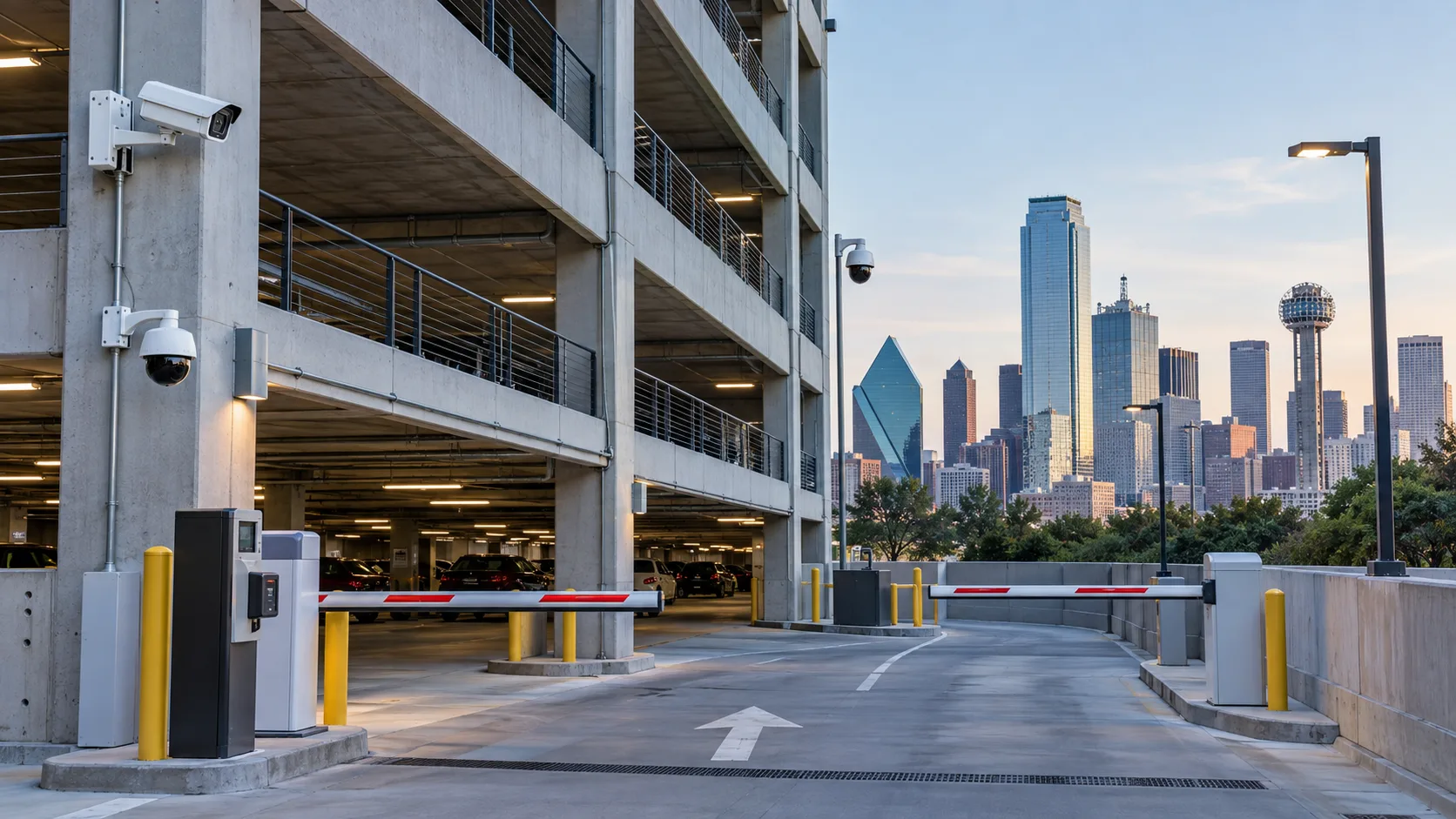
What Is a Parking Garage Security System?
A parking garage security system is a combination of hardware, software, and connectivity designed to monitor vehicle and pedestrian activity, control access, document incidents, and provide real-time visibility across a multi-level parking structure. A modern system can include any combination of the following:
- ✓CCTV / IP security cameras — the primary visual monitoring layer
- ✓LPR (license plate recognition) cameras — capture and log plates at entry and exit points
- ✓Video management software (VMS) — the platform that organizes, records, and plays back footage from all cameras
- ✓NVR or cloud recording — stores footage locally, in the cloud, or both
- ✓Access control — keycards, mobile credentials, or LPR-triggered gates that control who enters
- ✓Parking gates and barriers — physical access restriction tied to authorization
- ✓Intercoms — two-way communication at gates, elevators, or pedestrian entrances
- ✓Motion detection and video analytics — automated alerts for line-crossing, intrusion zones, or unusual activity
- ✓Remote access — live viewing and playback from any device, anywhere
- ✓Monitoring and alerts — notifications sent to management or a monitoring service when specific events are detected Not every garage needs every component. A 50-space surface-level structure attached to a small office building has different requirements than a 1,200-space downtown garage serving a mixed-use tower. The point is that the system should match the property — not the other way around.
Parking Garage Security Cameras: Where Should They Be Installed?
Camera placement in a parking structure is everything. A camera in the wrong spot — pointed at a wall, washed out by headlights, or mounted too high to capture faces — wastes money and creates a false sense of security. Here is a location-by-location breakdown of where cameras should go and why.
Garage Entrances and Exits
Every vehicle entering or leaving should be captured. That means cameras positioned to record the front plate, the rear plate (if needed), the driver area, and any gate interaction. Entry and exit points are where LPR cameras do their most important work — logging plates with timestamps so you have an accurate record of who was in the garage and when. Camera positioning here matters more than resolution. A 4K camera pointed at the wrong angle will miss plates that a properly positioned 2MP LPR camera captures every time.
Parking Ramps
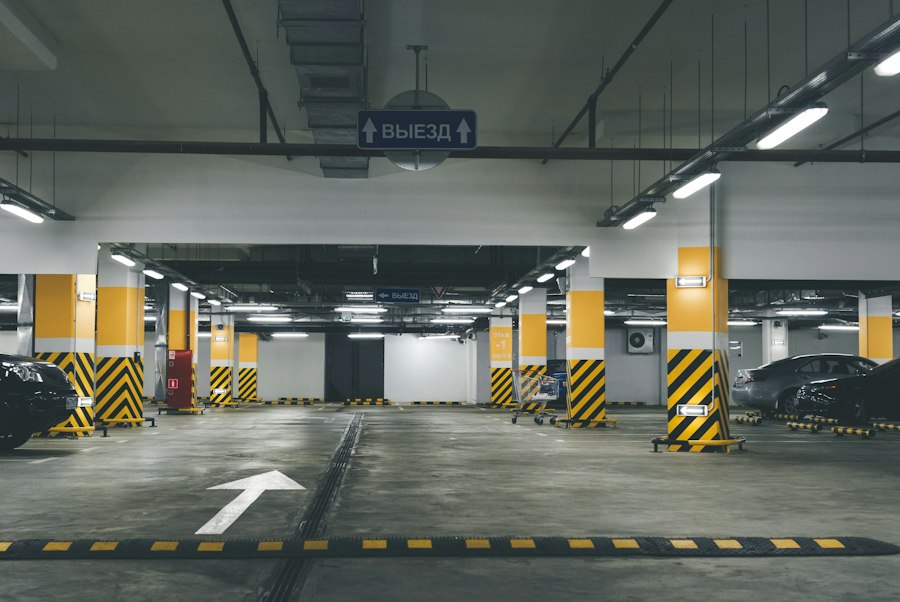
Ramps between levels are natural blind spots. Vehicles move through them quickly, and the transition between lighting zones can make footage unusable if the camera is not configured for the conditions. Ramp cameras document vehicle movement between floors, capture incidents like collisions or reckless driving, and cover areas where suspicious activity often goes unnoticed.
Parking Levels and Driving Aisles
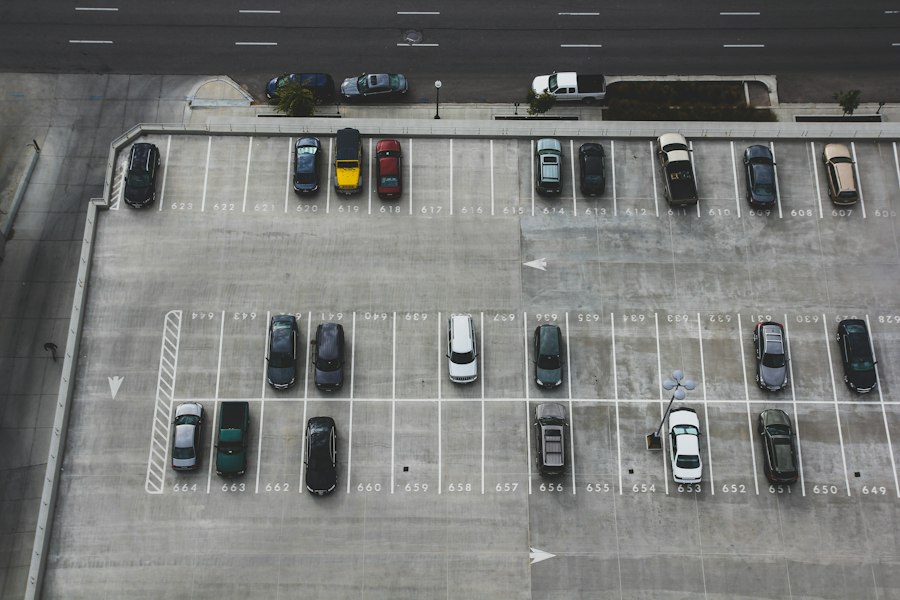
Each level needs coverage of the driving aisles and parked vehicle areas. Wide-angle cameras mounted along the ceiling or structural beams can cover long stretches of parking rows. The goal is to capture enough detail to identify vehicles, document incidents near parked cars, and monitor pedestrian movement — especially in areas far from elevators or stairwells. Columns and structural walls create natural blind spots on every floor. A site assessment identifies these and adjusts camera angles or adds coverage where needed.
Stairwells
Stairwells are enclosed, isolated, and often poorly lit — making them one of the highest-priority zones in any garage. Cameras at stairwell entrances on every level document who enters and exits. Inside the stairwell, cameras at landings can provide additional coverage, though lighting and mounting options vary widely depending on the structure.
Elevator Lobbies
Elevator entrances and lobbies connect the garage to the building it serves. Cameras here capture foot traffic moving between the parking area and the elevators, providing a clear record of who accessed the building and when. In garages that serve office towers or residential buildings, these cameras are among the most frequently reviewed during investigations.
Payment Stations and Kiosks
If the garage uses payment stations or ticket kiosks, cameras should cover these areas for documentation of transactions, disputes, tampering, or theft. A camera aimed at the kiosk screen and user area provides context that helps resolve billing issues and deters vandalism.
Perimeter and Pedestrian Entrances
Ground-level pedestrian entrances and garage perimeters are often the least monitored points in a parking structure. Cameras here capture people entering or exiting on foot, which is particularly important after business hours when vehicle gates may be closed but pedestrian doors remain accessible.
Which Security Cameras Are Best for Parking Garages?
There is no single camera that works for every spot in a parking garage. The right camera depends on where it is mounted, what it needs to capture, and the lighting conditions at that specific location.
IP Security Cameras
IP (Internet Protocol) cameras transmit video over a network, which means they can be managed, viewed, and recorded centrally through a VMS. For parking garages, IP cameras are the standard because they support remote access, higher resolutions, analytics, and scalable system design. Most commercial garage installations today use IP cameras across the board.
4K Security Cameras
4K cameras capture significantly more detail than standard 1080p models. In a parking garage, that extra resolution is useful in areas where you need to identify faces, read signage, or capture license plates at a distance. But 4K also requires more storage and bandwidth. Not every camera in the garage needs to be 4K — it makes sense at key identification points like entrances, exits, and elevator lobbies.
LPR / License Plate Recognition Cameras
LPR cameras are purpose-built to capture license plates clearly, even on moving vehicles and in variable lighting. They use infrared illumination and specialized lenses to read plates at entry and exit points. In a parking garage, LPR cameras serve a specific function that a standard wide-angle camera cannot replicate — they log every plate with a timestamp, which is essential for access control, parking management, and investigations.
PTZ Cameras
PTZ (pan-tilt-zoom) cameras can rotate and zoom remotely, making them useful for covering large open areas or providing situational awareness across an entire level. In parking garages, PTZ cameras are typically used in combination with fixed cameras — the fixed cameras provide constant coverage while the PTZ can be directed to a specific area during an incident or live monitoring session.
Varifocal Cameras
Varifocal cameras have adjustable focal lengths, which means the field of view can be tuned during installation. In a garage, this flexibility helps when the same camera model needs to cover a wide driving aisle on one floor and a narrower stairwell entrance on another. It reduces the number of camera models needed while still matching the lens to each location.
Low-Light and Night-Vision Cameras
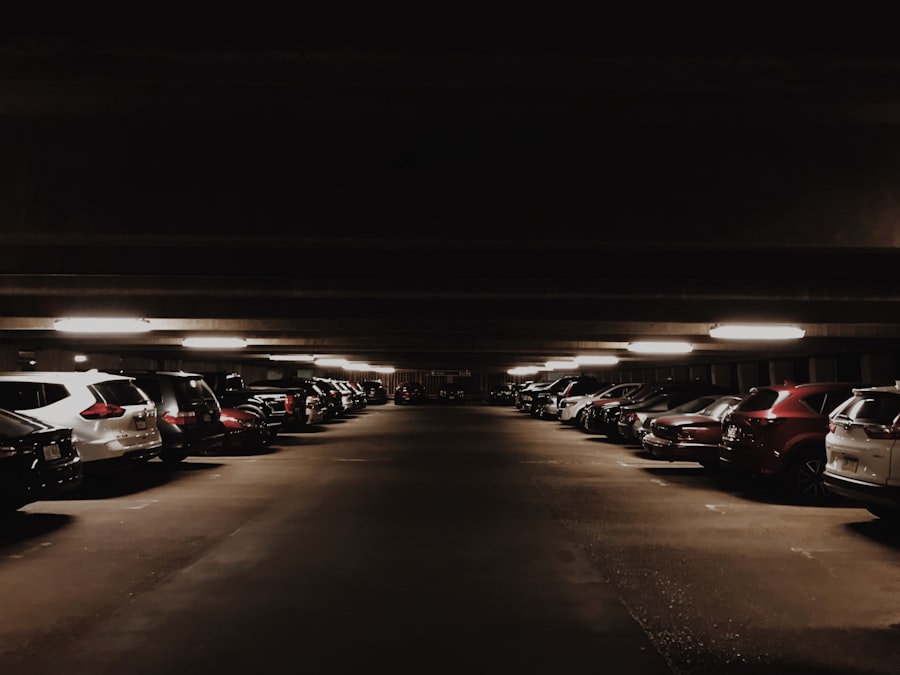
Parking garages have some of the most challenging lighting conditions in commercial security. Interior levels may have fluorescent lighting that creates harsh contrasts. Upper levels may have partial exposure to daylight that shifts throughout the day. Underground levels may be almost completely dark after hours. Cameras rated for low-light performance — including models with IR (infrared) illumination — are essential in any garage system.
AI-Enabled Security Cameras
Some commercial cameras include on-board analytics that can detect specific types of activity — a person entering a restricted zone, a vehicle crossing a virtual line, or motion in an area that should be empty after hours. These analytics can generate alerts that notify property management or a monitoring service.
Parking Garage Camera Comparison
| Camera Type | Best Used For | Parking Garage Application |
|---|---|---|
| IP Camera | General surveillance, remote access | Standard coverage across all levels |
| 4K Camera | High-detail identification | Entrances, exits, elevator lobbies |
| LPR Camera | License plate capture | Entry/exit gates, access logging |
| PTZ Camera | Wide-area monitoring, zoom | Large open levels, incident response |
| Varifocal | Adjustable field of view | Mixed locations — aisles and corridors |
| Low-Light / IR | Dark or variable lighting | Underground levels, stairwells, after-hours |
| AI-Enabled | Activity detection, alerts | Restricted zones, perimeter, after-hours |
Manufacturers like Vivotek produce commercial-grade IP cameras specifically designed for challenging environments like parking structures, with models rated for low light, wide dynamic range, and vandal resistance. [Link to Vivotek commercial IP camera solutions]
Parking Garage CCTV Camera Systems vs. Standard Security Cameras
The term “CCTV” — closed-circuit television — goes back decades. It originally referred to analog cameras wired directly to a local monitor and recorder. You could watch live footage on-site, but that was about it. Modern parking garage surveillance systems use IP cameras connected over a network. The footage is managed through video management software, recorded to an NVR or cloud platform, and accessible remotely from a phone, tablet, or computer anywhere in the world. The terminology has not caught up with the technology. Many property managers still search for “CCTV installation” when what they actually need is a networked IP camera system with remote access, analytics, and integration with access control.
| Feature | Traditional CCTV (Analog) | Modern IP Camera System |
|---|---|---|
| Image Quality | Standard definition (480–720p) | HD to 4K (1080p–4K+) |
| Remote Viewing | Limited or none | Full remote access from any device |
| Recording | Local DVR only | NVR, cloud, or hybrid |
| Scalability | Hard-wired, limited expansion | Network-based, easy to scale |
| Analytics | None | Motion detection, line-crossing, person/vehicle detection |
| Integration | Standalone | Access control, LPR, intercoms, gates |
| Cabling | Coaxial (BNC) | Cat6 Ethernet (PoE) |
The practical takeaway: focus on what the system does, not what it is called. A well-designed IP system with the right cameras, storage, and remote access will outperform a bank of 4K cameras dumping footage to an undersized recorder with no remote access and no analytics.
Integrating Parking Garage Cameras With Access Control
Cameras and access control systems do different jobs, but they are far more useful when they work together. Access control manages who gets in — through gates, doors, card readers, mobile credentials, or LPR verification. Cameras document what happens. When the two are integrated, you get a complete picture: not just that a gate opened at 2:47 a.m., but who was in the vehicle, what they did, and where they went. Here is a simple real-world workflow:
- ✓Vehicle approaches the entry gate
- ✓LPR camera captures the license plate
- ✓Access control system checks the plate against an authorized list
- ✓Gate opens (or remains closed if unauthorized)
- ✓Camera records the full event — plate, vehicle, timestamp
- ✓Footage is stored and available for review or investigation This same integration works with keycards at pedestrian entrances, mobile credentials for tenant parking, intercoms at visitor gates, and door access control in stairwells connecting the garage to the building. If your property needs access control installation in Dallas — whether for a parking garage, an office building, or both — the system should be designed so cameras and access hardware share data and work from the same management platform. Security In DFW installs integrated systems where Avigilon access control and video platforms work together to give property managers a single view of every access event and the camera footage tied to it.
LPR Cameras for Parking Garage Security
License plate recognition deserves its own section because it solves a problem that no other camera type addresses the same way. A standard wide-angle security camera can show you that a silver sedan entered the garage at 3:15 p.m. An LPR camera tells you the exact plate number, logs it to a database, and — if connected to an access system — verifies whether that vehicle is authorized to be there.
How LPR Works
LPR cameras use infrared illumination and a specialized lens to capture license plates on moving vehicles, day or night. The camera feeds the image to software that reads the plate characters and matches them against a database — an authorized tenant list, a visitor log, or a flagged vehicle list.
Where LPR Fits in a Parking Garage
- ✓Entry and exit monitoring — logging every vehicle that enters or leaves with a plate number and timestamp
- ✓Authorized vehicle verification — automatically opening gates for tenants or permit holders without a card or ticket
- ✓Investigation support — when an incident happens, LPR logs let you identify every vehicle that was present during the timeframe
- ✓Parking management — tracking occupancy, duration, and turnover by plate
- ✓Integration with gates and access control — LPR as a credential, replacing or supplementing keycards
What Makes LPR Different From a Normal Camera
An LPR camera is not a wide-angle camera zoomed in. It uses a narrow field of view, controlled infrared lighting, and specific shutter speeds tuned to capture plates at vehicle speeds. Mounting position, angle, and distance from the lane all affect capture accuracy. A camera mounted too high, too far from the lane, or at the wrong angle will miss plates or produce unreadable images. LPR also requires consistent lighting control. In a garage, that usually means the camera provides its own IR illumination rather than relying on ambient garage lighting, which can vary dramatically between levels and times of day. No LPR system captures every plate perfectly under every condition — heavy rain, mud-covered plates, temporary paper plates, and extreme angles all affect read rates. But a properly installed LPR system in a parking garage consistently captures the vast majority of plates and provides a searchable log that no other camera type can replicate.
Video Monitoring and Remote Access
Installing cameras is only half the equation. The other half is making sure someone can actually see what those cameras capture — and respond when something happens.
Live Viewing and Remote Access
Modern parking garage camera systems support live viewing from any internet-connected device. Property managers, building engineers, and security staff can pull up a live feed from their phone, tablet, or desktop — whether they are on-site, at home, or managing multiple properties across Dallas. This is not a nice-to-have feature. For property managers overseeing multiple garages or commercial buildings, the ability to check a camera feed without driving to the site saves time and provides peace of mind.
Alerts and Notifications
When cameras include analytics — motion detection, line-crossing, intrusion zones — the system can send alerts when specific events are detected. A motion alert from a restricted area at midnight is more useful than reviewing eight hours of footage the next morning.
Understanding Monitoring Options
There are meaningful differences between how parking garage footage gets watched:
| Monitoring Type | What It Means | Best For |
|---|---|---|
| Self-Monitoring | Property manager or staff review footage as needed | Smaller garages, incident-only review |
| Remote Viewing | Staff access live feeds and playback from any device | Multi-property management, spot checks |
| Professional Live Monitoring | A third-party monitoring center watches live feeds and responds to alerts | High-security properties, after-hours coverage |
Security In DFW installs systems that support self-monitoring and remote viewing. For properties that need professional live video monitoring, we can design systems compatible with third-party monitoring services and configure alerts and video feeds accordingly.
Video Storage: NVR, Cloud, or Hybrid?
Every camera in your parking garage generates footage that needs to go somewhere. How and where you store that footage affects your budget, your access to recordings, and how long you can keep them.
NVR / Local Storage
A network video recorder (NVR) stores footage on-site, typically in a secure server room, electrical closet, or equipment cabinet within the parking structure or the building it serves. NVR storage gives you fast local access to recordings, no recurring cloud subscription fees, and full control over your data. The tradeoffs: if the NVR is stolen, damaged, or loses power, you may lose footage. Physical security of the recording equipment matters. Network connectivity between cameras and the NVR must be reliable, and storage capacity determines how many days or weeks of footage you can retain.
Cloud Recording
Cloud storage sends footage off-site to a remote data center. You can access recordings from anywhere, and footage is protected even if something happens to the on-site equipment. Cloud storage scales easily — adding cameras or extending retention is a configuration change, not a hardware upgrade. The tradeoff is cost. Cloud recording typically involves a monthly per-camera fee. For a 40-camera parking garage, those recurring costs add up. Bandwidth requirements also increase, which may require network upgrades.
Hybrid Storage
A hybrid approach records to a local NVR for primary storage and mirrors critical camera feeds — entrances, exits, LPR — to the cloud. This gives you the speed of local storage with the redundancy of cloud backup for your most important footage. For most commercial parking garages in Dallas, a hybrid approach strikes the right balance. Factors That Affect Storage Requirements
| Factor | Impact on Storage |
|---|---|
| Number of cameras | More cameras = more footage to store |
| Resolution (1080p vs. 4K) | 4K footage uses roughly 3–4× more storage than 1080p |
| Frame rate | Higher frame rates produce smoother video but larger files |
| Recording schedule | Continuous recording uses more storage than motion-only recording |
| Motion-based recording | Records only when activity is detected — significantly reduces storage needs |
| Retention period | 30 days of retention requires far less storage than 90 days |
During the system design phase, Security In DFW calculates storage requirements based on your camera count, resolution, recording mode, and desired retention period — so you are not guessing about how much storage you actually need. Need help designing a parking garage security system? Schedule a Free On-Site Assessment — Call Security In DFW or Request a Quote Online.
How Professional Parking Garage Camera Installation Works
A parking garage camera installation is not the same as mounting a few cameras inside an office. The structure is larger, the environment is harsher, the cabling runs are longer, and the number of variables — from lighting to structural obstructions — is significantly higher. Here is how Security In DFW approaches a parking garage installation from start to finish.
Step 1: Site Assessment
Everything starts with a physical walkthrough of the garage. Our team visits the property and documents every detail that affects camera placement and system design:
- ✓Number of entrances and exits — vehicle and pedestrian
- ✓Ramp locations and transitions between levels
- ✓Total number of levels and approximate parking capacity
- ✓Stairwell locations and access points on each floor
- ✓Elevator lobbies and connections to the main building
- ✓Existing lighting conditions — including underground levels, partially open upper decks, and areas where lighting varies by time of day
- ✓Blind spots created by columns, walls, mechanical equipment, or signage
- ✓Existing conduit, cabling, or previous camera infrastructure
- ✓Location of electrical panels and network equipment We take photos, measure distances, and note ceiling heights, mounting surfaces, and any environmental factors like exposure to weather on open levels. This assessment is free and takes anywhere from one to three hours depending on the size of the structure.
Step 2: Security Design and Camera Placement Plan
Using the site assessment data, we create a camera placement plan that maps every camera location to a specific coverage objective. No guesswork, no generic templates. Each camera in the plan has a defined purpose — covering an entrance lane, capturing plates at the exit gate, monitoring a stairwell landing, or providing wide-angle coverage of a parking level. We identify the camera type, lens, mounting position, and viewing angle for each location. The plan also identifies where LPR cameras need to be positioned relative to the driving lane, what angle and distance will produce the best plate capture, and where analytics zones should be drawn for motion or intrusion alerts.
Step 3: Camera and System Selection
We match the camera hardware to each location. A low-light camera for a poorly lit underground level. An LPR camera at the entry gate. A 4K camera at the elevator lobby where facial identification matters. A varifocal camera along a driving aisle where the distance to subject varies. We also spec the NVR or hybrid storage solution, the VMS platform, and any integration points — access control panels, gate controllers, intercoms, or third-party monitoring feeds.
Step 4: Cabling and Infrastructure
Most commercial IP camera systems run on Cat6 Ethernet cable with Power over Ethernet (PoE), which carries both data and power on a single cable. For a parking garage, cabling is one of the most labor-intensive parts of the project. Runs may extend hundreds of feet across multiple levels. Cable needs to be routed through conduit to protect against physical damage, moisture, and temperature extremes — especially on open upper decks. We identify the best conduit paths during the assessment and plan cable runs to minimize distance while maintaining signal quality. Network switches, patch panels, and power supplies are installed in a secure, ventilated equipment location — typically a server room or locked electrical closet within the building.
Step 5: Installation and Configuration
Cameras are mounted at the locations specified in the placement plan. Each camera is positioned, angled, and secured to match the coverage objective for that location. The VMS is configured with camera feeds, recording schedules, analytics zones, user access permissions, and alert rules. If the system integrates with access control, parking gates, or intercoms, those connections are configured and tested as part of this step.
Step 6: Testing
Before we consider the system complete, every camera and every system function gets tested:
- ✓Image quality verification at each camera — daytime and simulated low-light conditions
- ✓Camera angles checked against the placement plan
- ✓Night and low-light performance reviewed for every camera
- ✓Recording verified — footage is writing to the NVR or cloud and playing back correctly
- ✓Remote viewing confirmed from mobile and desktop devices
- ✓Alerts and analytics tested — motion zones, line-crossing, intrusion alerts triggered and delivered
- ✓Access control and gate integration verified end to end If something does not perform as designed, we adjust it before we leave.
Step 7: Training and Ongoing Support
We walk the property manager, building engineer, or security director through the entire system. How to view live feeds. How to search and play back footage. How to export clips. How to manage alerts. How to add or remove user access. How to check system health. We do not hand over a login and leave. The people who manage the building day-to-day should feel confident using the system without calling us for basic tasks. After installation, Security In DFW provides ongoing support — system health checks, firmware updates, camera repositioning when tenants or layouts change, and troubleshooting when something is not working as expected.
How Many Security Cameras Does a Parking Garage Need?
There is no universal number. A three-level garage attached to a medical office in Plano has different requirements than an eight-level downtown Dallas structure serving a mixed-use development. The camera count depends on the physical characteristics of the garage and the level of coverage the property requires. Factors That Determine Camera Count
| Factor | How It Affects Camera Count |
|---|---|
| Number of floors | Each level needs its own set of cameras — ramps, aisles, stairwells |
| Number of entrances/exits | Each vehicle and pedestrian entry point needs dedicated coverage |
| Ramp count | Each ramp transition between levels requires at least one camera |
| Stairwells | Each stairwell entrance on every level is a camera location |
| Elevator lobbies | At minimum, one camera per elevator lobby per floor |
| Parking capacity | Larger floors with more spaces need wider coverage or more cameras |
| Lighting conditions | Poor lighting may require additional cameras with IR illumination |
| LPR requirements | Each lane requiring plate capture needs a dedicated LPR camera |
| Desired identification detail | Close-up identification requires tighter angles — more cameras for same area |
| Blind spots | Columns, walls, and equipment create dead zones needing additional coverage |
As a rough frame of reference: a straightforward three-level garage with two entry/exit lanes, two stairwells, one elevator lobby per floor, and standard coverage might need 20 to 35 cameras. A large downtown structure with eight levels, multiple entry points, LPR on every lane, and elevator lobbies connecting to an office tower could require 60 to 100 or more. But those ranges are meaningless without a site assessment. The only accurate camera count comes from walking the garage, identifying every coverage zone, and designing the system around the actual layout. Want to know how many cameras your parking garage needs? Request a Free Site Assessment from Security In DFW.
How Much Does Parking Garage Camera Installation Cost in Dallas?
We are not going to give you a number and pretend it applies to your property. Parking garage security system costs vary significantly based on the scope of the project, and publishing a fixed price would be misleading. What we can do is explain exactly what drives the cost so you understand what you are paying for. Cost Factors for Parking Garage Security Systems
| Cost Factor | What It Covers | Impact on Budget |
|---|---|---|
| Camera count | Total number of cameras installed | The single largest variable — more cameras = more hardware, cabling, labor |
| Camera type | Standard IP, 4K, LPR, PTZ | LPR and 4K cameras cost more per unit than standard 1080p models |
| LPR requirements | Dedicated plate capture cameras | LPR cameras and management software add to the base cost |
| Cabling | Cat6 Ethernet runs to NVR/switches | Multi-level garages require long runs — major labor component |
| Network infrastructure | PoE switches, patch panels, config | Larger systems need more switching capacity |
| NVR / storage | Local recording hardware and drives | More cameras + higher resolution = larger NVR and more storage |
| Mounting requirements | Brackets, conduit, pole mounts | Concrete ceilings and exterior mounts add labor and hardware |
| Number of floors | Each level multiplies cabling and labor | A six-level garage costs more than a two-level garage, all else equal |
| Access control integration | Gates, card readers, intercoms | Integration adds hardware, licensing, and configuration time |
| Monitoring setup | Alerts, analytics, remote access | More analytics zones and alerts require more configuration |
| Existing infrastructure | Reusing conduit, cabling, mounts | Can reduce cost — only if existing infrastructure meets standards |
What Does a Typical Project Range Look Like? A small parking structure — two or three levels, 15 to 25 cameras, basic NVR recording, no LPR — might fall in the range of a standard commercial security camera installation. A larger garage with LPR, access control integration, cloud or hybrid storage, and 50-plus cameras is a larger capital project with more infrastructure work. Rather than guessing, the most practical path is to schedule a site assessment. We walk the garage, scope the project, and provide a detailed proposal that itemizes every component — cameras, cabling, NVR, licensing, labor, and any integration work. No surprises. Get a Real Number for Your Parking Garage — Schedule a Free On-Site Assessment with Security In DFW.
Benefits of a Professionally Designed Parking Garage Security System
A security system that was designed around the specific layout and risk profile of your parking structure delivers practical value that a generic camera installation cannot match.
- ✓Visibility into every level, ramp, stairwell, and entry point — not just the areas visible from a guard booth
- ✓Deterrence — visible cameras and controlled access discourage theft, vandalism, and unauthorized entry
- ✓Incident documentation — when something happens, you have clear footage tied to a timestamp, plate number, or access event
- ✓Vehicle monitoring — LPR logs provide a complete record of every vehicle that entered or exited the garage
- ✓Faster investigation — instead of reviewing hours of footage manually, analytics and LPR search narrow the timeline to seconds
- ✓Remote visibility — property managers and security staff can view any camera from any device, without being on-site
- ✓Reduced blind spots — a site-assessed placement plan covers the areas that off-the-shelf installations miss
- ✓Better management oversight — occupancy patterns, after-hours activity, and gate usage data help with operational decisions
- ✓Scalability — a properly designed IP system can expand as the property changes or new levels are added
- ✓Integration with building security — cameras, access control, intercoms, and gates working on a single platform None of this is guaranteed to prevent every incident. But a well-designed system consistently gives property managers better information, faster response, and stronger documentation — which is the foundation of effective commercial security.
Parking Garage Security Systems for Different Commercial Properties
Parking garages serve very different populations depending on the property they are attached to. The security system should reflect those differences.
Office Buildings
Tenant parking in an office tower typically involves assigned spaces, access-controlled gates, and a mix of daily commuters and visitor traffic. LPR and keycard-controlled gates handle access. Cameras focus on vehicle entry, elevator lobbies, and stairwells. In downtown Dallas and Uptown, where garages serve buildings with multiple tenants, the system often needs to segment access by floor or zone.
Multi-Tenant Commercial Properties
Properties with multiple businesses sharing a garage need clear documentation of access events and a system flexible enough to manage different access levels for different tenants. Analytics can help identify unauthorized parking or after-hours access in tenant-reserved areas.
Residential and Mixed-Use Buildings
Condo buildings, apartment complexes, and mixed-use developments in areas like Victory Park, Deep Ellum, and the Design District often include structured parking for residents and guests. Resident access via LPR or mobile credentials, visitor intercoms, and cameras covering vehicle and pedestrian areas are standard. Resident safety expectations tend to be higher, which means stairwell and elevator lobby coverage is non-negotiable.
Hospitals and Healthcare Facilities
Medical campus garages serve patients, visitors, staff, and emergency vehicles. High traffic volume, extended operating hours, and patient safety concerns require broad camera coverage, well-lit monitoring of pedestrian areas, and integration with the facility’s broader security infrastructure. Garages attached to hospitals along the Medical District corridor or in Richardson and Plano are commonly multi-level with high daily turnover.
Hotels and Hospitality Properties
Guest parking garages need to balance security with a welcoming visitor experience. LPR can verify registered guests. Cameras document vehicle activity and cover walkways between the garage and the hotel entrance. After-hours monitoring is particularly important because guest garages are often accessible 24/7.
Retail Centers
Retail parking structures — especially those connected to high-traffic shopping centers or entertainment districts — deal with high vehicle turnover, theft from vehicles, and pedestrian safety during evening hours. Camera coverage of driving aisles, perimeter entrances, and payment areas is essential.
Universities and Schools
Campus parking garages serve students, faculty, staff, and visitors with varying access levels. LPR-based access control can manage permit verification without physical gates. Cameras provide documentation for vehicle incidents, and stairwell coverage is a priority for campus safety programs.
Municipal and Government Facilities
City-owned garages and parking structures at government buildings often require compliance with specific security standards. Camera systems may need to feed into a centralized monitoring platform shared with other facilities.
Corporate Campuses
Large employers in the DFW area — particularly along the Telecom Corridor, Legacy West, and Las Colinas — operate campus parking structures for thousands of employees. These systems often integrate with enterprise access control platforms and may include visitor management, reserved executive parking zones, and EV charging station monitoring.
Construction and Development Projects
New parking structures under construction benefit from temporary camera systems during the build phase to monitor equipment, materials, and after-hours access. Once the structure is complete, the permanent security system is designed and installed based on the finished layout.
What to Look for When Choosing a Parking Garage Security Camera Installer in Dallas
Not every security camera company has experience working in parking garages. The installation environment, the cabling requirements, and the system design challenges are meaningfully different from a standard office or retail project. Here is what to look for: Installer Evaluation Checklist
| Criteria | What to Ask or Verify |
|---|---|
| Texas license | Is the company a licensed security systems installer in Texas? Ask for the license number. |
| Commercial experience | How many commercial security camera systems has the company installed? Ask for references. |
| Parking facility experience | Has the company installed cameras specifically in parking garages — not just parking lots? |
| Site assessment process | Does the company perform a physical walkthrough before quoting? Phone-only quotes are a red flag. |
| Camera placement expertise | Can they explain where cameras need to go and why — not just how many? |
| LPR capability | Do they have experience with LPR installation, positioning, and software configuration? |
| Low-light expertise | Do they plan for lighting conditions including underground and partially open levels? |
| Cabling and network knowledge | Can they handle long Cat6 runs, conduit, PoE switching, and multi-floor network config? |
| Access control integration | Can they tie cameras into gates, card readers, intercoms, and LPR-based access? |
| Storage planning | Do they calculate storage based on camera count, resolution, and retention — or just sell a standard NVR? |
| System testing | Do they test every camera, alert, remote connection, and integration before handoff? |
| Maintenance and support | What happens after installation? Ongoing support, firmware updates, troubleshooting? |
| Scalability | Can the system grow if you add a level, entrance, or more cameras? |
| Clear scope of work | Does the proposal itemize every camera, cable run, equipment, and labor task? |
Security In DFW is a Texas licensed security systems installer serving commercial properties across the Dallas–Fort Worth area. We include every item on this checklist in our standard project approach — because parking garage installations require it.
Why Choose Security In DFW for Parking Garage Security Systems?
We install parking garage security systems because we understand what it takes to get them right — not because it is a line item on a services page.
- ✓Texas licensed security systems installer
- ✓Commercial security camera and access control experience across the DFW metro
- ✓Free on-site security assessments for parking garages and commercial properties
- ✓Custom camera placement plans designed around the actual structure — not a template
- ✓Experience with IP cameras, LPR systems, 4K cameras, and analytics-enabled cameras from commercial-grade manufacturers
- ✓Full system integration — cameras, access control, parking gates, intercoms, and VMS on a single platform
- ✓Professional cabling and network infrastructure installation — Cat6, PoE, conduit, patch panels
- ✓Complete system testing before handoff — image quality, night performance, remote access, alerts, and integrations
- ✓Training for your property management and security staff
- ✓Ongoing support — system health checks, firmware updates, troubleshooting, and system expansion
- ✓Dallas, Fort Worth, Plano, Richardson, Irving, Frisco, Arlington, and the surrounding DFW area We do not subcontract the installation. We do not quote without seeing the garage. We do not install a system and disappear. Schedule a Free On-Site Security Assessment — Call Security In DFW or Request a Quote Online
Frequently Asked Questions
There is no single best camera. Parking garages typically need a combination of IP cameras for general coverage, LPR cameras at entry and exit points, low-light cameras for underground levels, and potentially 4K cameras at identification-critical locations like elevator lobbies. The right mix depends on the layout, lighting, and security objectives of your specific garage.
It depends on the number of levels, entrances, exits, stairwells, elevators, and the desired level of coverage. A small three-level garage might need 20 to 35 cameras. A large multi-level structure could require 60 or more. The only way to get an accurate count is a professional site assessment.
Yes. LPR cameras log every license plate entering and exiting the garage with a timestamp. That data supports access control, parking management, and incident investigation. LPR can also automate gate access for authorized vehicles, replacing or supplementing keycards and tickets.
Yes, with the right cameras. Parking garages have challenging low-light conditions, especially on underground levels and after hours. Cameras with IR illumination and wide dynamic range are designed for these environments. Proper camera selection and positioning — determined during a site assessment — ensures usable footage around the clock.
At minimum: every vehicle entrance and exit, every ramp between levels, stairwell entrances on each floor, elevator lobbies, payment kiosks, and pedestrian entry points. Additional cameras cover driving aisles, perimeter areas, and any blind spots created by columns or structural walls. Exact placement is determined by the layout of the specific garage.
Yes. Cameras can work alongside parking gates, keycards, mobile credentials, LPR-based access, intercoms, and door access control. When integrated, every access event is tied to camera footage — so you know not just that a gate opened, but who was there and what happened.
Yes. Modern IP camera systems support live viewing and recorded playback from any internet-connected device — phone, tablet, or computer. You can check camera feeds from anywhere, whether you are on-site, at home, or managing another property across Dallas.
Most commercial properties retain footage for 30 to 90 days. The right retention period depends on your property’s risk profile, lease requirements, insurance recommendations, and any applicable local regulations. Storage requirements increase with longer retention, higher resolution, and more cameras.
Cost varies based on camera count, camera types, cabling runs, number of floors, NVR or cloud storage, access control integration, and the condition of existing infrastructure. The most accurate way to get a number is to schedule a free site assessment, where we scope the project and provide a detailed, itemized proposal.
Installation timelines depend on the project scope. A small garage with 15 to 25 cameras might take three to five business days. A larger structure with 50-plus cameras, LPR, and access control integration could take two to four weeks. We provide a timeline estimate as part of every proposal.
In many cases, yes. If the existing cabling and conduit are in good condition, new cameras and recording equipment can be installed using the existing infrastructure. During a site assessment, we evaluate what can be reused and what needs to be replaced — which can reduce the overall project cost.
AI-enabled cameras can add value by detecting specific activity — a person entering a restricted zone, a vehicle crossing a virtual boundary, or motion in an area that should be empty after hours. These analytics generate alerts that surface relevant events faster than manual footage review. They do not replace a complete system, and they do not physically prevent incidents — but they can reduce response time and improve incident awareness.
A parking lot is a single, open-air surface with relatively simple sightlines and consistent lighting. A parking garage is a multi-level enclosed or partially enclosed structure with variable lighting, structural obstructions, ramps, stairwells, and elevator lobbies. Garage surveillance requires more cameras, more varied camera types, more cabling, and a design plan that accounts for the vertical, three-dimensional layout that a flat lot does not have.
Protect Your Parking Garage — Start With a Free Security Assessment
Whether you manage a three-level garage attached to a medical office or an eight-level structure serving a downtown Dallas office tower, the security system should be built around your facility — not copied from a template. Security In DFW provides free on-site security assessments for commercial parking garages across the Dallas–Fort Worth area. We walk the structure, identify every coverage zone, and design a camera placement plan that addresses your specific layout, lighting, access control needs, and LPR requirements. From camera selection to cabling, installation, testing, and ongoing support — we handle the entire project so you get a system that actually works. Schedule Your Free Parking Garage Security Assessment — Contact Security In DFW Today